Time Based Key-Value Store
1. Problem & Core Objective
Design a key-value store that keeps multiple values per key, each stamped with a time, and can retrieve the value that was current at any past moment.
set(key, value, timestamp)      // store
get(key, timestamp)             // the value with the LARGEST timestamp <= timestamp,
                                // or "" if none exists
set("foo","bar",1); get("foo",1) → "bar"
get("foo",3) → "bar" (nothing newer than 1 yet)
set("foo","bar2",4); get("foo",4) → "bar2"
get("foo",5) → "bar2"Constraints: 1 <= key.length, value.length <= 100 · 1 <= timestamp <= 10^7 · up to 2 × 10^5 calls · all set calls for a key arrive with strictly increasing timestamps
What's actually being tested: recognizing that "largest timestamp ≤ query" is a floor query, which is a boundary binary search — not an exact match. The strictly-increasing guarantee is what makes each key's history already sorted, so no sorting is ever needed.
2. First-Principles Thought Process
Read the guarantee
"All the timestamps of
setare strictly increasing."
That single line means each key's list of (timestamp, value) pairs is already sorted by timestamp — appending keeps it sorted, and you never re-sort.
Without it you'd need a TreeMap per key or a sort on every get.
The query is a floor, not a match
get("foo", 3) doesn't ask "what was set at time 3" — nothing was. It asks for the newest value at or before time 3.
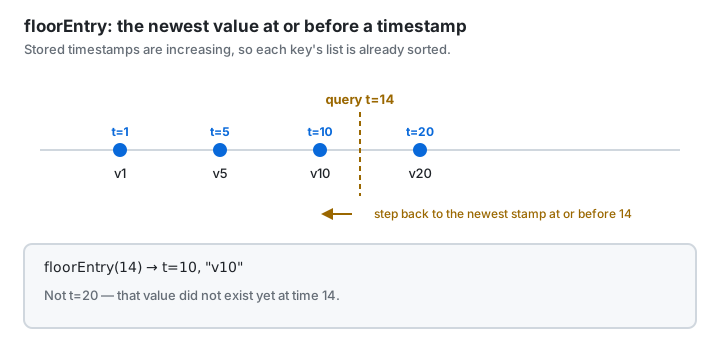
That's a floor query: the largest key ≤ the target. In binary search terms it's a boundary — you're looking for where the timestamps stop being ≤ the query.
The structure
Map<String, List<(timestamp, value)>>— a hash map forO(1)key lookup, and a list per key kept in insertion order.setisO(1)amortized: append.getisO(log n)over that key's list.
The hash map and the binary search do different jobs — one finds the key, the other finds the moment. Both are needed, and saying so shows you've separated the two dimensions.
The "remember the candidate" idiom
When list[mid].timestamp <= query, mid is a valid answer — but a later one might be better. So record it and keep searching right:
if (stamp <= query) { best = value; lo = mid + 1; }   // candidate — try for newer
else                { hi = mid - 1; }                  // too late — go earlier
That's the floor-query shape, and it differs from exact-match search in exactly that one line.
3. Solution Paths
Approach 1 — Linear scan backwards (brute force)
class TimeMap {
    private final Map<String, List<Object[]>> store = new HashMap<>();

    public void set(String key, String value, int timestamp) {
        store.computeIfAbsent(key, k -> new ArrayList<>()).add(new Object[]{timestamp, value});
    }

    public String get(String key, int timestamp) {
        List<Object[]> list = store.getOrDefault(key, List.of());
        for (int i = list.size() - 1; i >= 0; i--) {              // newest first
            if ((int) list.get(i)[0] <= timestamp) return (String) list.get(i)[1];
        }
        return "";
    }
}
Walk backwards from the newest entry; the first one at or before the query is the answer.
- Time
setO(1),getO(n)in that key's history · SpaceO(n)
Counter-questions on this approach
⭐ "The list is already sorted. What does scanning throw away?"
The ability to halve. Because timestamps arrive strictly increasing, the list is sorted by construction — so a comparison at the midpoint rules out an entire half. Scanning backwards treats it as an unordered log.
"Why scan backwards rather than forwards?"
Because the answer is the newest qualifying entry, and going backwards I can return on the first hit. Forwards I'd have to scan the whole list to be sure nothing newer qualified. It's the right instinct for a linear scan — it just doesn't fix the complexity.
"How bad is it?"
With
2 × 10^5calls, an adversary can put nearly all of them on one key:10^5sets then10^5gets, each scanning10^5entries →10^10operations. Not borderline.
Approach 2 — Binary search per key (optimal)
class TimeMap {
    private final Map<String, List<int[]>>  times  = new HashMap<>();   // key -> timestamps
    private final Map<String, List<String>> values = new HashMap<>();   // key -> values

    public void set(String key, String value, int timestamp) {
        times.computeIfAbsent(key,  k -> new ArrayList<>()).add(new int[]{timestamp});
        values.computeIfAbsent(key, k -> new ArrayList<>()).add(value);
    }

    public String get(String key, int timestamp) {
        List<int[]>  ts = times.get(key);
        List<String> vs = values.get(key);
        if (ts == null) return "";

        String best = "";
        int lo = 0, hi = ts.size() - 1;

        while (lo <= hi) {
            int mid = lo + (hi - lo) / 2;
            if (ts.get(mid)[0] <= timestamp) {
                best = vs.get(mid);      // a candidate — remember it
                lo = mid + 1;            // ...but look for a newer one
            } else {
                hi = mid - 1;            // too late — go earlier
            }
        }
        return best;
    }
}
(Two parallel lists keep the timestamps in a primitive-friendly structure; a single list of small records is equally fine and reads better — see §5.)
Trace — key has timestamps [1, 5, 10, 20] with values v1, v5, v10, v20; query t = 14:
| Step | lo | hi | mid | stamp | ≤ 14? | best | Action |
|---|---|---|---|---|---|---|---|
| 1 | 0 | 3 | 1 | 5 | yes | v5 | lo = 2 |
| 2 | 2 | 3 | 2 | 10 | yes | v10 | lo = 3 |
| 3 | 3 | 3 | 3 | 20 | no | v10 | hi = 2 |
| — | 3 | 2 | — | — | loop ends | return v10 ✓ |
Note step 3: the algorithm tried for something newer, found 20 was too late, and fell back on the candidate it had already recorded. That's the floor-query pattern working.
- Time
setO(1),getO(log n)· SpaceO(n)
Counter-questions on this approach
⭐ "Why record best inside the loop instead of returning when you find a match?"
Because this isn't an exact-match search. When
stamp <= timestamp, that entry is a valid answer — but a later entry might also qualify and be better, since I want the largest timestamp ≤ the query. So I record it as the best so far and keep searching right. Returning immediately would give an arbitrary qualifying entry, not the newest.
⭐ "Why is the list sorted? You never sort it."
The problem guarantees
setcalls for a key arrive with strictly increasing timestamps, so appending preserves order. That's the constraint doing the work — without it I'd need aTreeMap<Integer, String>per key, payingO(log n)onsetas well asget.
"What if the key has never been set?"
times.get(key)returnsnulland I return"". Note I usegetplus a null check rather thangetOrDefault(key, List.of())— either works, but with two parallel maps a single null check is clearer than two defaults.
"What's the complexity across all calls?"
O(1)persetandO(log n)perget, wherenis that one key's history — not the total number of entries. With2 × 10^5calls that's at most about 18 comparisons perget.
"Could you return the timestamp too, not just the value?"
Yes — record
ts.get(mid)[0]alongsidebest. It's free, since you're already at that entry. Worth mentioning because a real cache would want to know how stale the value is.
Approach 3 — TreeMap per key
class TimeMap {
    private final Map<String, TreeMap<Integer, String>> store = new HashMap<>();

    public void set(String key, String value, int timestamp) {
        store.computeIfAbsent(key, k -> new TreeMap<>()).put(timestamp, value);
    }

    public String get(String key, int timestamp) {
        TreeMap<Integer, String> tm = store.get(key);
        if (tm == null) return "";
        Map.Entry<Integer, String> e = tm.floorEntry(timestamp);    // the query, literally
        return e == null ? "" : e.getValue();
    }
}
TreeMap.floorEntry is the floor query, built in.
- Time
setO(log n),getO(log n)· SpaceO(n)
Counter-questions on this approach
⭐ "This is three lines. Why would you ever write the binary search by hand?"
Because the interview is testing whether I can implement a floor query, and
floorEntryhides exactly the thing being assessed. In production I'd use theTreeMap— it's clearer and handles unordered inserts for free.It's also slightly worse here:
setbecomesO(log n)instead ofO(1), because a red-black tree has to maintain order on every insert — order the problem already guarantees. I'd state both, write the binary search, and mention this as the production answer.
"When would the TreeMap genuinely be better?"
The moment the strictly-increasing guarantee disappears. With out-of-order
setcalls, the list approach needs insertion into the middle atO(n)or a re-sort; theTreeMaphandles it atO(log n)with no code change. That's the §7 follow-up.
"Why floorEntry rather than floorKey?"
floorKeyreturns just the timestamp, so I'd need a second lookup to get the value.floorEntryreturns both in one operation. See 02 §3.
Comparison
| Approach | set | get | Notes |
|---|---|---|---|
| Backward scan | O(1) | O(n) | 10^10 worst case |
| Binary search | O(1) | O(log n) | What the question is testing |
TreeMap.floorEntry | O(log n) | O(log n) | Production answer; hides the mechanic |
4. Why the Optimal Wins
Against the scan: the history is sorted by construction, so a midpoint comparison discards half of it. O(n) → O(log n) per get, and with 10^5 gets against a 10^5-entry history that's 10^10 versus 2 × 10^6.
Against the TreeMap: the same get complexity, but set stays O(1) because we exploit the increasing-timestamp guarantee rather than re-establishing order the input already has. Paying O(log n) on insert to maintain an order you were given for free is paying twice.
The framing worth keeping:
"Newest value at or before time T" is a floor query, and a floor query is a boundary binary search — record the candidate, keep going right.
The same shape answers "largest element ≤ x", "last version before a release", and range-start lookups in interval problems.
5. Java Prerequisites
Floor query by hand
if (stamp <= query) { best = value; lo = mid + 1; }   // candidate; try for a later one
else                { hi = mid - 1; }
The "remember and keep going" line is what distinguishes a floor query from exact match.
TreeMap navigation
tm.floorEntry(x);      // greatest entry with key <= x   (null if none)
tm.ceilingEntry(x);    // smallest entry with key >= x
tm.lowerEntry(x);      // strictly <
tm.higherEntry(x);     // strictly >
floor goes down, ceiling goes up; lower/higher are the strict versions.
Grouping with computeIfAbsent
store.computeIfAbsent(key, k -> new ArrayList<>()).add(entry);Creates the list on first use and returns it either way, so the .add chains directly. See 02 §1.3.
A cleaner entry type. Parallel lists work but are easy to desynchronize. A record reads better:
record Stamped(int time, String value) {}
Map<String, List<Stamped>> store = new HashMap<>();
6. Interview Communication Guide
Clarifying questions: Are set timestamps strictly increasing per key (yes — this is the key guarantee)? Can two values share a timestamp (no, given "strictly")? What should get return for an unknown key or a query before the first set ("")?
The pitch
"Two dimensions here. Finding the key is a hash map lookup,
O(1). Finding the right moment within that key's history is the interesting part.
getisn't an exact-match query —get(\"foo\", 3)asks for the newest value at or before time 3, even if nothing was set at 3. That's a floor query.The problem guarantees
settimestamps arrive strictly increasing per key, so each key's history is already sorted just by appending. No sorting needed, andsetstaysO(1).For
getI binary search that list. The detail that makes it a floor query rather than an exact match: when the midpoint's timestamp is ≤ my query, that's a valid answer, but a later one might be better — so I record it and keep searching right. If nothing newer qualifies, I fall back on the recorded candidate.
O(1)set,O(log n)get,O(n)space.In production I'd use a
TreeMapper key and callfloorEntry, which is literally this query built in. But that hides the mechanic being tested, and it makessetO(log n)to maintain an order the input already guarantees."
Edge cases to volunteer:
| Scenario | Expected | Tests |
|---|---|---|
get before any set for that key | "" | Null key handling |
get with a timestamp before the first set | "" | Every entry is too late — best stays "" |
get with a timestamp after the last set | the newest value | Loop runs right to the end |
get exactly on a stored timestamp | that value | <= must be inclusive |
| One key, many entries | O(log n) | The complexity is per key, not global |
| Many keys, one entry each | O(1) effectively | Hash map does the work |
The "query before the first set" case is the one to name — it's the only path where the loop finds no candidate at all, and it's what justifies initializing best to "" rather than to the first element.
7. Follow-Up Questions — Modified Constraints
⭐ "What if set calls arrived out of order?"
The list is no longer sorted by appending, so binary search breaks. Options: insert at the correct position —
O(n)persetdue to shifting — or switch to aTreeMapper key, which givesO(log n)for both operations with no code change. This is exactly where theTreeMapearns its keep, and it's why I'd mention it even while writing the binary search.
"Support deleting a key's value at a given time."
Store a tombstone — a sentinel value marking deletion — as a normal timestamped entry.
getthen returns""if the floor entry is a tombstone. This is how log-structured stores handle deletes: nothing is removed, a newer record supersedes it.
"Return all values in a time range [t1, t2]."
Binary search for the lower and upper boundaries and return the slice between —
O(log n + k)forkresults. With aTreeMapit'ssubMap(t1, true, t2, true)directly.
"What if the history per key grew unbounded?"
Two directions. Compaction: drop entries older than a retention window, which keeps
getfast and bounds memory. Tiering: keep recent entries in memory and older ones on disk, binary searching the in-memory portion first. That's roughly what an LSM-tree does.
"Make it thread-safe."
ConcurrentHashMapfor the outer map handles concurrent keys. Within a key, appends and binary searches race — aCopyOnWriteArrayListmakes reads lock-free at the cost of expensive writes, which suits read-heavy loads. Alternatively lock per key, which keeps writes cheap and contention localized.
"What if you needed the value at time T across all keys — a global snapshot?"
The per-key structure doesn't answer this efficiently; you'd run the floor query on every key,
O(k log n)forkkeys. For frequent snapshots you'd maintain a global version counter and index by it — essentially MVCC, the mechanism real databases use for consistent reads.