2-D Dynamic Programming
11 questions, and the hardest DP in the set. The second dimension means different things in different problems, and recognising which kind you have is most of the work.
What the second dimension actually is
| Meaning | Questions |
|---|---|
| a second sequence index | 2, 6, 8, 9, 11 |
| a grid coordinate | 1, 7 |
| a state in a machine | 3 |
| a capacity / target | 4, 5 |
| an interval endpoint | 10 |
Best Time to Buy and Sell with Cooldown is "2-D" only in that its second index is a state label — HOLD, SOLD, REST. Burst Balloons is 2-D because dp[i][j] is an interval.
The dependency pattern decides the fill order
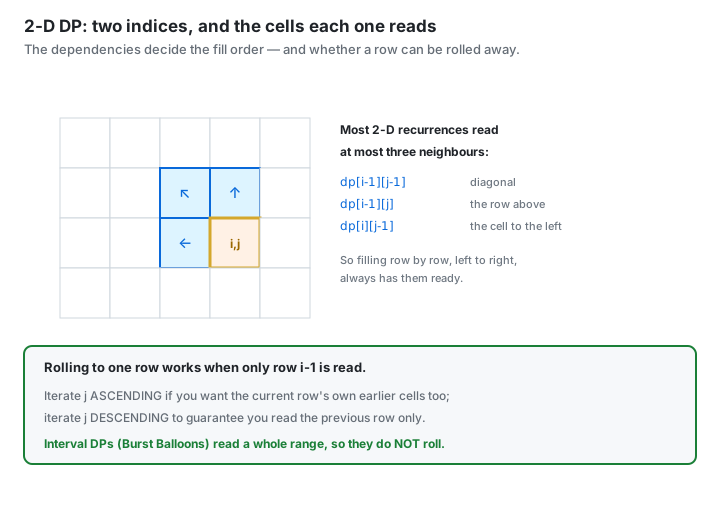
Most recurrences read at most three neighbours — above, left, diagonal — so row-major, left-to-right works. Interval DPs are the exception: they read a whole range and must be filled by increasing interval length.
Rolling: which direction, and why
The loop direction follows from which generation you need to read, not from convention.
| Need | Direction | Questions |
|---|---|---|
| current row's left neighbour | ascending | 1 (Unique Paths) |
| previous row's diagonal | descending | 8 (Distinct Subsequences), 0/1 knapsack |
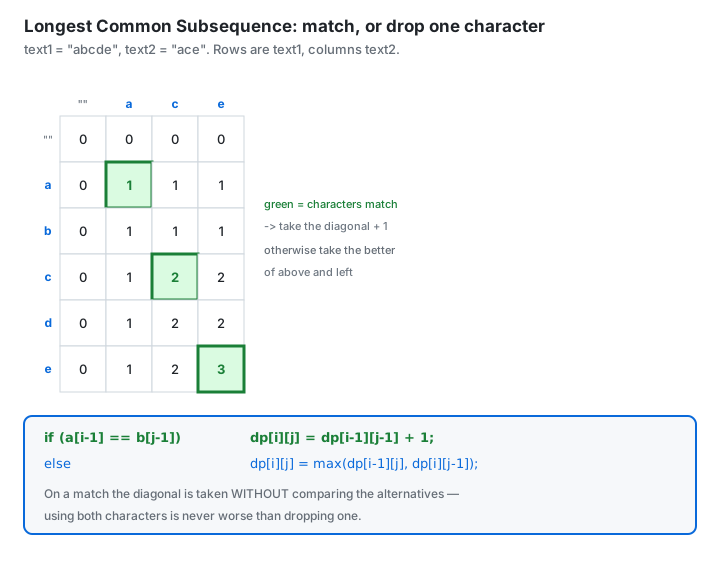
| both above and diagonal | two rows, or one plus a saved variable | 2 (LCS), 9 (Edit Distance) |
| a whole range | cannot roll | 10 (Burst Balloons) |
Unique Paths rolls to one array with dp[j] += dp[j-1], where dp[j] is still the stale "above" and dp[j-1] is the fresh "left". Edit Distance rolls to one array plus one variable holding the diagonal — the leaner alternative to LCS's two rows.
Loop order can change the answer
Coin Change II has two independent loop-order decisions, and conflating them is the usual confusion:
| Decision | Choice | Effect |
|---|---|---|
| which loop is outer | coins | combinations, not permutations |
| which direction the amount runs | ascending | unlimited reuse, not 0/1 |
Verified: for amount = 5, coins = [1,2,5], coins-outer gives 4 and amount-outer gives 9. Same array, same recurrence, same complexity.
The reframe that makes Burst Balloons tractable
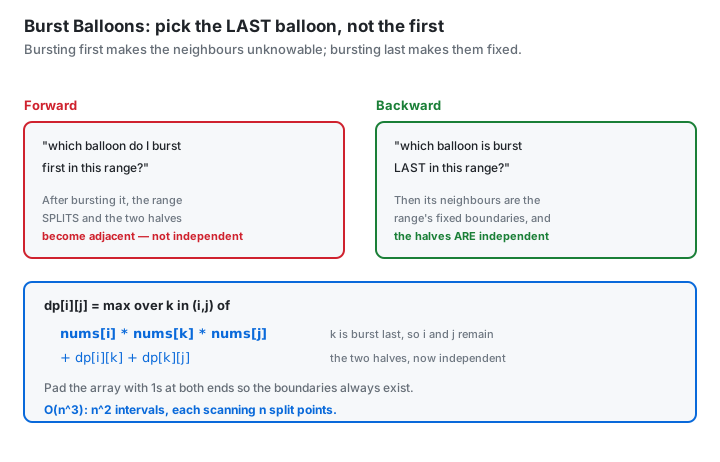
Asking "which balloon bursts first" leaves subproblems that interact — the halves become adjacent. Asking "which bursts last" fixes its neighbours as the interval's boundaries, making the halves genuinely independent.
O(n!) → O(n³), purely from changing the question. The same shape solves Matrix Chain Multiplication and Optimal BST.
Where top-down beats bottom-up
Unusually, two questions are better memoised than tabulated:
Question 7 — tabulating needs cells in increasing value order, so you'd sort all m·n of them at O(m·n log(m·n)). The DFS discovers a valid order for free.
Question 11 — the lookahead at p[j+1] reads naturally forwards; bottom-up must look backwards at p[j-1] and p[j-2] and seed row 0 by hand.
The traps
| Trap | Symptom |
|---|---|
| Zero base cases in Edit Distance (Q9) | ("abc","") returns 0 instead of 3 |
| Not seeding row 0 in regex (Q11) | ("", "a*") returns false |
Putting the skip in an else (Q8) | "rabbbit"→"rabbit" returns 1, not 3 |
| Advancing the pattern on star-match (Q11) | * becomes "exactly one" |
| Swapping insert and delete (Q9) | Plausible table, wrong on asymmetric input |
| Wrong loop nesting (Q4) | Counts permutations instead of combinations |
| Ascending in 0/1 knapsack (Q5) | Each number signed twice |
Missing |target| > total (Q5) | Negative array size — a crash, not a wrong answer |
Adding a visited array (Q7) | Breaks memo reuse across starting cells |
Tracking k separately (Q6) | 100×100×200 table, mostly unreachable |
| Asking "which bursts first" (Q10) | Subproblems interact; no DP possible |
Verification
Every snippet compiled and cross-checked against an independent implementation — 3,200+ randomized cases:
- Q1 across the DP, the recursion and the closed-form binomial
- Q8 across the 2-D table, the rolled row and the recursion
- Q9 across 2-D and rolled, plus symmetry (
d(a,b) == d(b,a)) asserted on every case - Q10 against every-burst-order brute force —
O(n!)on small inputs - Q11 against the recursive matcher on randomly generated patterns
Two deliberately-broken variants confirm the headline traps:
- omitting Edit Distance's edge base cases returns 0 for
("abc", "")where the answer is 3 - omitting regex's row-0 seeding returns false for
("", "a*")