Graphs
13 questions — the largest section after Trees, and the one where recognising which standard traversal applies is most of the work.
Seven of thirteen are grids
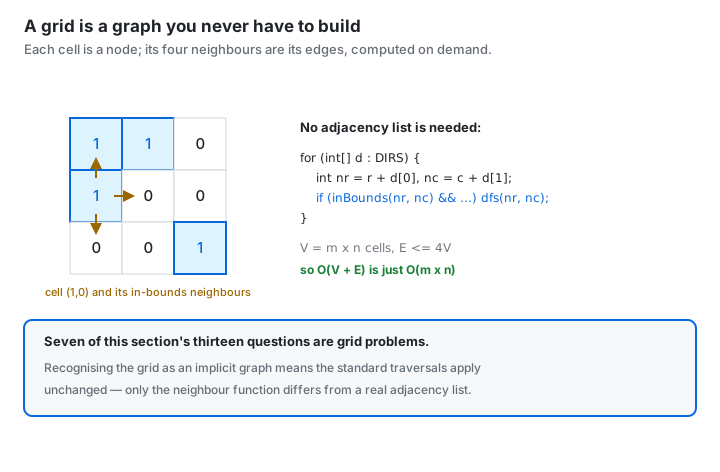
Each cell is a node; its four neighbours are its edges, computed arithmetically. With V = m·n and E ≤ 4V, every traversal is O(m·n). No adjacency list is ever built.
Choosing the traversal
| Question shape | Algorithm | Questions |
|---|---|---|
| Count / measure components | DFS or BFS flood | 1, 2, 11 |
| Shortest path, unweighted | BFS | 13 |
| Distance to the nearest of many sources | multi-source BFS | 4, 5 |
| Copy a structure with cycles | DFS/BFS + a map | 3 |
| Cycle detection, directed | 3-colour DFS or Kahn's | 8, 9 |
| Cycle detection, undirected | union-find, or DFS with a parent check | 10, 12 |
| Reachability for every cell | reverse the search | 6, 7 |
DFS vs BFS for pure reachability is a genuine trade: O(depth) stack against O(width) queue. At 300 × 300 an all-land grid is one 90,000-cell island, which overflows the default JVM stack — so BFS is the safe default at that size.
Multi-source BFS
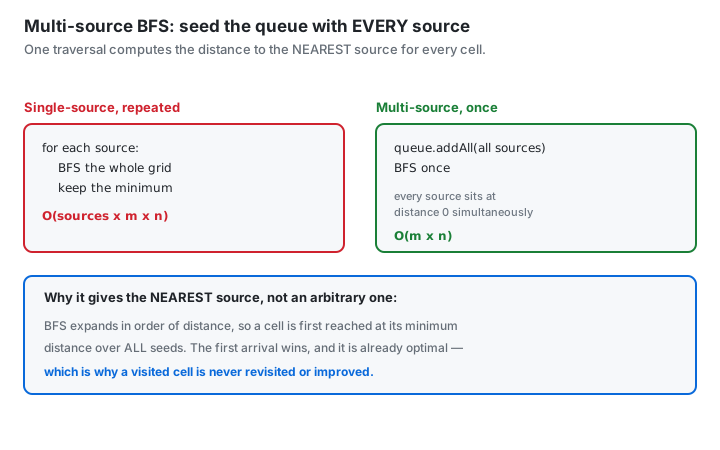
Seeding every source at distance 0 turns O(sources · m · n) into O(m · n). It's correct because BFS expands in order of distance from the seed set, so a cell's first arrival is already its minimum — no cell ever needs updating.
Questions 4 and 5 are the same algorithm; only what you record differs (a per-cell distance vs a level count).
Reversing the question
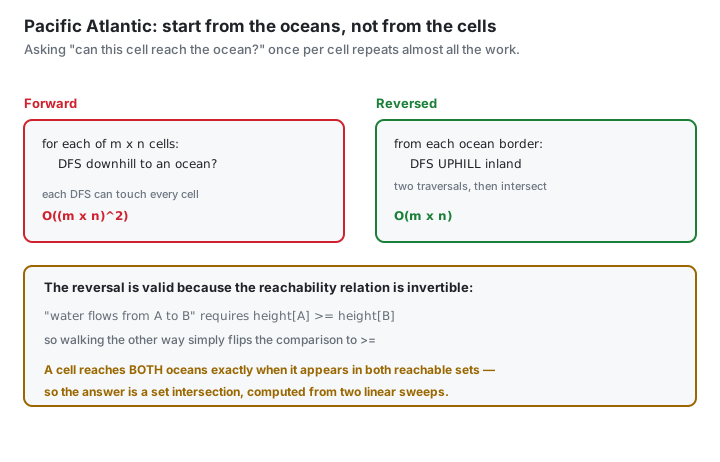
When "can X reach the target?" must be answered for every X, invert it to "what can the target reach?". One traversal replaces n of them — O((m·n)²) → O(m·n).
The reversal needs the relation to be invertible. In Pacific Atlantic, A → B iff height[A] >= height[B], which reads identically backwards. Surrounded Regions applies the same idea to a membership test: "surrounded" is hard to check, "touches the border" is trivial, and everything unmarked is surrounded by definition.
Cycle detection needs three states
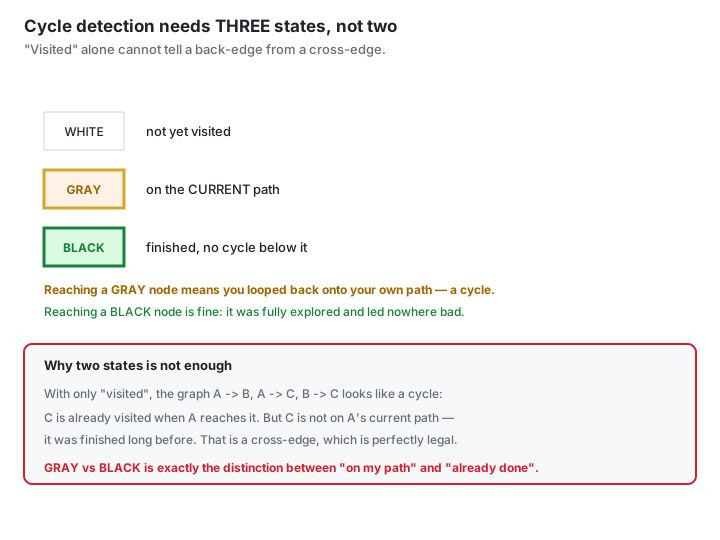
A plain visited set conflates "on my current path" with "already finished". Only the first is a cycle.
Verified: on the acyclic diamond A→B, A→C, B→C, a two-state check reports a cycle. Three colours correctly report none.
And in an undirected graph the problem is different again — every edge looks like a back-edge to its own parent — so you track the parent or use union-find, which has no notion of direction.
Union-Find
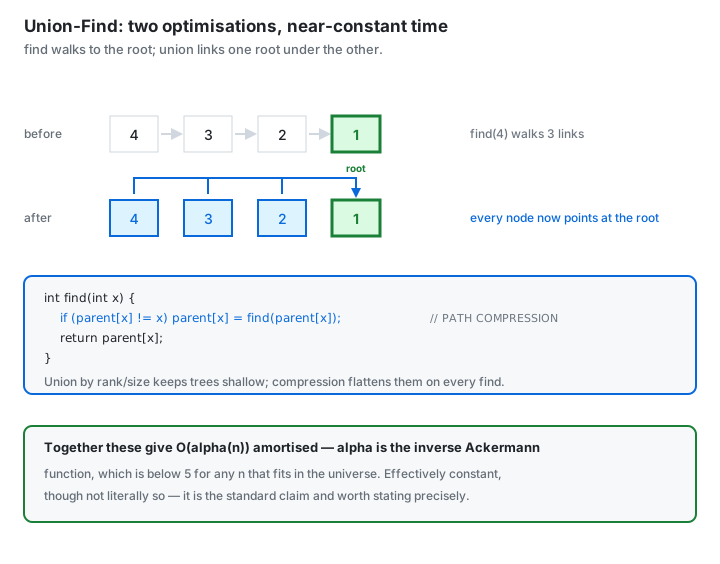
Two independent optimisations: union by size stops deep chains forming, path compression flattens whatever chains exist. Either alone gives O(log n); together, O(α(n)) — inverse Ackermann, below 5 for any n that fits in the universe. Effectively constant, not literally so.
The same test means different things in three questions:
find(u) == find(v) | Meaning | Question |
|---|---|---|
| reject | a cycle — not a tree | 10 |
| skip | a redundant edge; count unchanged | 11 |
| return it | this is the redundant edge | 12 |
The n − 1 edge theorem
A connected graph needs at least n − 1 edges; an acyclic one has at most n − 1. So with exactly n − 1, connected ⟺ acyclic — check either and you've proved both.
But n − 1 edges alone proves nothing: a triangle plus an isolated node has n − 1 edges and is neither connected nor acyclic.
Word Ladder: the adjacency is the bottleneck
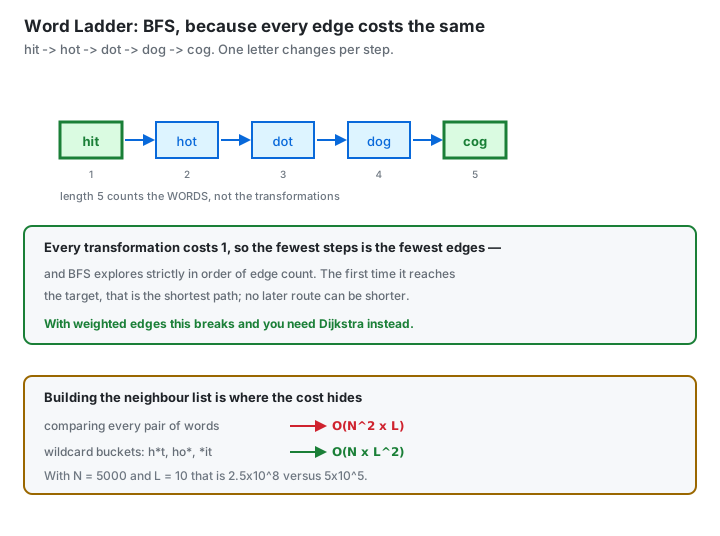
The BFS is standard. Comparing every pair of words to find neighbours is O(N² · L) = 2.5 × 10^8; bucketing by wildcard pattern (h*t, ho*, *it) is O(N · L²) = 5 × 10^5. Roughly 500×, and it's why the problem is Hard.
The traps
| Trap | Symptom |
|---|---|
| DFS on a 300×300 all-land grid (Q1) | 90,000 frames — stack overflow |
| Marking visited on dequeue, not enqueue | Duplicates in the queue; work multiplies |
| Not registering the copy before recursing (Q3) | Infinite recursion on any undirected edge |
Counting -1 for zero fresh oranges (Q5) | Should be 0 |
| Missing the level snapshot (Q5) | Everything rots in one minute |
| Inverting the height comparison (Q6) | Plausible wrong answer, not a crash |
| ` | |
| Two-state cycle detection (Q8) | Reports cycles in DAGs |
| Iterating edges, not nodes (Q11) | Isolated nodes uncounted |
int[n] for 1-indexed nodes (Q12) | Index out of bounds on node n |
| Pairwise word comparison (Q13) | O(N²·L) — times out |
Verification
Every snippet compiled and cross-checked against an independent implementation — 4,300+ randomized cases:
- Q1 across DFS, BFS and union-find
- Q3 verified structurally: the clone shares no node with the original, and the neighbour correspondence is bijective
- Q4 against a per-room BFS; Q5 against a whole-grid simulation
- Q6 against a forward per-cell DFS — the
O((m·n)²)version the optimal replaces - Q8/Q9 with Kahn's and three-colour cross-checked, and every returned order independently re-verified as a valid topological sort
- Q12 against a remove-and-test reference, confirming the tie-break claim: union-find's first hit really is the last valid edge
- Q13 with wildcard buckets checked against pairwise comparison
One deliberately-broken variant confirms the headline trap: a two-state cycle check reports a cycle on the acyclic diamond 0→1, 0→2, 1→2.