Linked List
11 questions. The section where almost every bug is the same bug: you overwrote a pointer before saving what it pointed at.
The one idea
A linked list has no indices, no length, and no way to go backwards. All you ever hold is a handful of pointers into a structure that you are also rewiring. So:
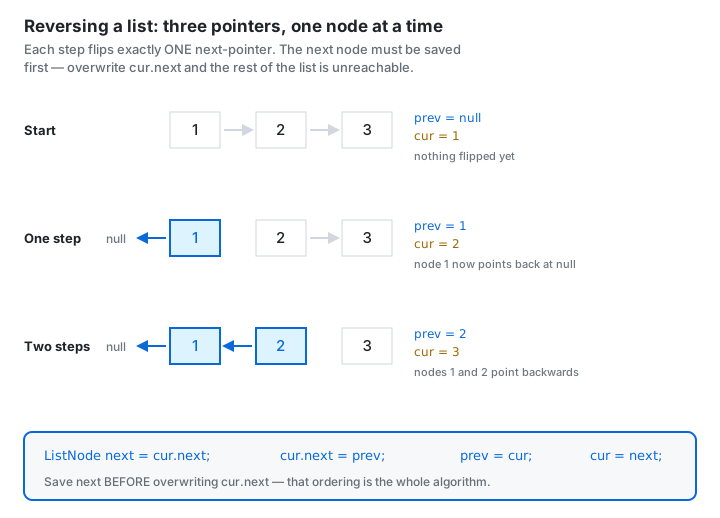
Before you overwrite a pointer, save what it pointed at. Your only reference to the rest of the structure is the pointer you are about to destroy.
Every question here is that discipline plus one technique.
The four techniques
1. Pointer reversal — flip every next, carrying prev, cur and a saved next. (Q1, and reused inside Q3 and Q11)
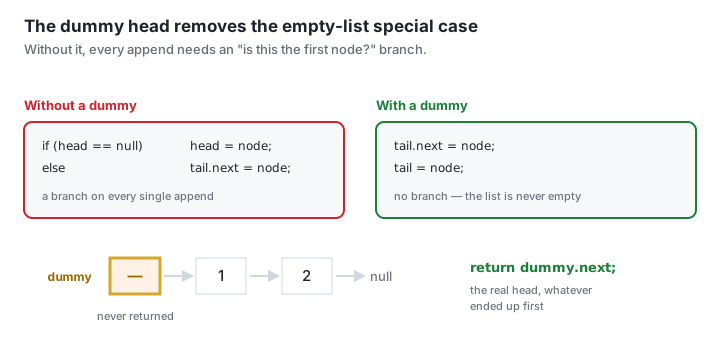
2. The dummy head — allocate a throwaway node in front of the list so that "append the first node" and "remove the head" stop being special cases. (Q2, Q4, Q6, Q9, Q10, Q11 — six of eleven)
3. Two pointers — in two flavours, and it's worth keeping them distinct:
- Fixed gap — open a gap of
nand slide both. When the leader hits the end, the trailer isnfrom it. (Q4) - Different speeds —
fastmoves two,slowmoves one. Used to find the middle (Q3) and to detect cycles (Q7, Q8).
4. Compose two structures — when one structure can't give you both properties you need, wire two together. (Q9)
Floyd's cycle detection — the one to actually understand
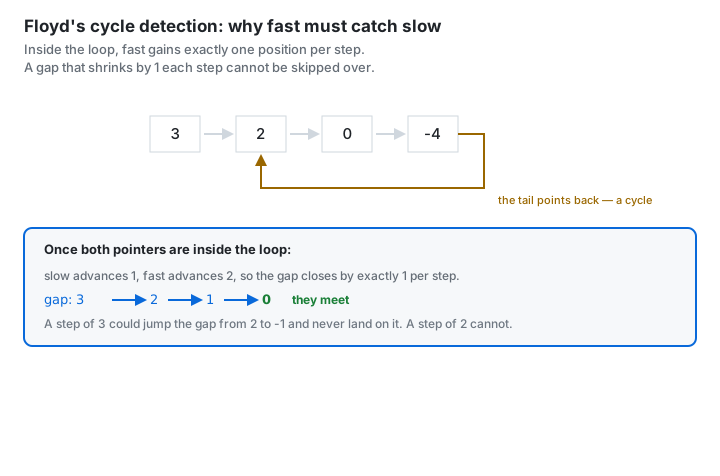
Two pointers, one moving twice as fast. If there's a cycle they must meet, because the gap between them shrinks by exactly 1 each step and a quantity decreasing by exactly 1 cannot skip zero.
Finding where the cycle starts needs one more step, and one piece of algebra:
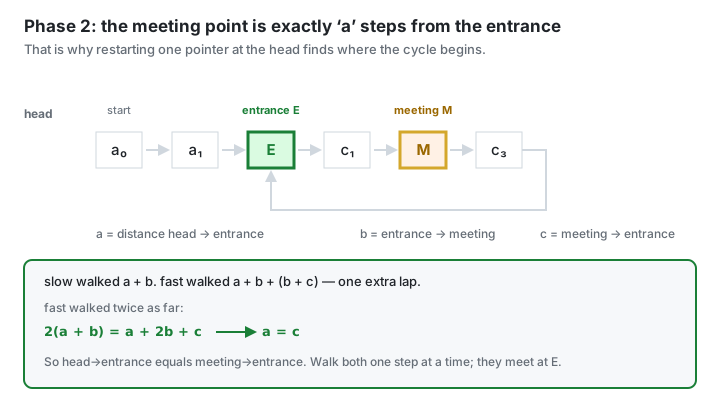
slow walked a + b; fast walked twice that. If fast lapped once, it walked a + b + (b + c). So 2(a+b) = a + 2b + c, giving a = c — the head-to-entrance distance equals the meeting-point-to-entrance distance.
This is what makes question 8 possible, where there is no list at all — just an array whose values happen to be valid indices.
The null-check that appears everywhere
while (fast != null && fast.next != null)Both clauses, in that order. fast.next.next dereferences twice, so you must establish both before hopping — and && short-circuits, so swapping the operands throws on a null head.
The traps
| Trap | Symptom |
|---|---|
Overwriting cur.next before saving it | The rest of the list is unreachable |
prev = cur before cur.next = prev | Self-loop; infinite list |
Forgetting slow.next = null when splitting (Q3) | Halves stay joined; weave never terminates |
while (fast != null) instead of fast.next != null (Q4) | slow lands one node too far |
| Dropping the final carry (Q6) | 99 + 1 returns 0, not 100 |
Comparing slow.val == fast.val (Q7) | Duplicate values look like a cycle |
| Singly linked list in an LRU (Q9) | Unlink becomes O(n); the design collapses |
| Merging k lists one at a time (Q10) | O(N·k) — the accumulator is re-walked |
| Reversing before checking k nodes remain (Q11) | A partial tail gets reversed and can't be cheaply undone |
Verification
Every Java snippet in this section was compiled and cross-checked against an independent implementation — 5,000+ randomized cases, including:
- three reversal implementations agreeing on 500 random lists
- Q5 verified structurally: the copy shares no node with the original, every
randomlands on the correct copy, and the input is left byte-for-byte intact - Q6 checked against
BigIntegeron 600 random pairs - Q9 checked against
LinkedHashMapin access-order mode over 400 traces of 60 operations - Q11 checked against an independent array-chunk reversal
Two deliberately-broken variants confirm the guards are load-bearing rather than decorative:
- dropping
carry != 0from Q6's loop condition returns[0,0]for99 + 1instead of[0,0,1] - not moving the node on
getin Q9 turns LRU into FIFO — it disagreed on 1,055 lookups