Advanced Graphs
6 questions, each a named algorithm. The work is recognising which one applies — and, in two cases, noticing that the obvious choice is wrong.
The algorithms
| Algorithm | Solves | Question |
|---|---|---|
| Hierholzer's | Eulerian path — use every edge once | 1 |
| Prim's / Kruskal's | minimum spanning tree | 2 |
| Dijkstra | shortest path, non-negative weights | 3, 4 |
| Topological sort | ordering from constraints | 5 |
| Bellman-Ford | shortest path with a hop limit | 6 |
Weighted edges break BFS
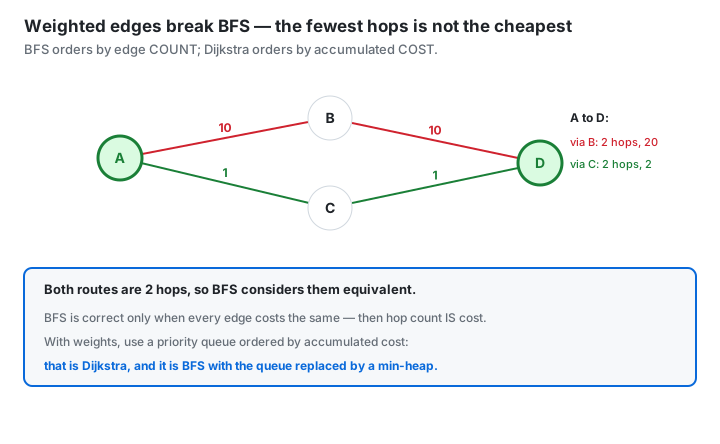
Dijkstra is BFS with the FIFO queue replaced by a min-heap ordered by accumulated cost. When all weights are equal the two coincide — which is exactly why BFS works in Word Ladder and fails here.
Dijkstra's invariant: the first pop of a node is final, because every remaining entry costs at least as much and can only grow. That argument requires non-negative weights.
Dijkstra generalises beyond addition
Question 4 is the surprise. The path cost there is a max, not a sum — the time a route becomes swimmable is its highest elevation. Dijkstra still works, because its correctness needs only that extending a path never lowers its cost:
max(a, b) >= a so the invariant holdsThat unlocks minimax paths, maximum-capacity paths, and probability products — none of which are additive.
Where the obvious choice is wrong
| Question | Obvious | Why it fails | Correct |
|---|---|---|---|
| 1 | greedy smallest-next | strands tickets at a dead end | Hierholzer's — record dead ends, don't backtrack |
| 6 | Dijkstra | a hop cap breaks first-pop-is-final | Bellman-Ford with bounded rounds |
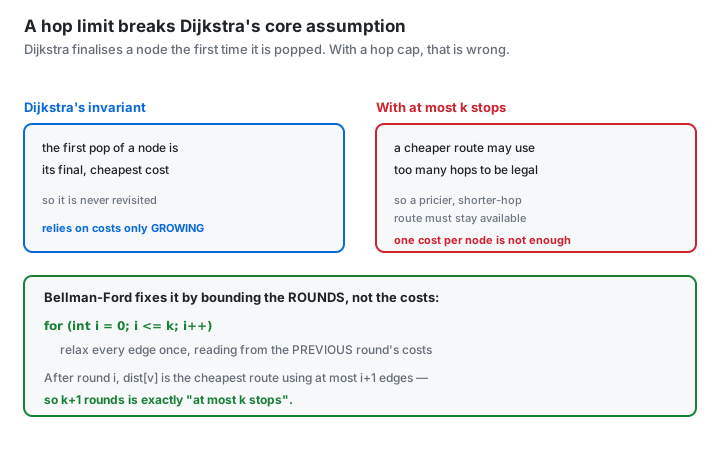
With a hop budget, a cheaper route may use too many hops to continue — so a pricier short route must stay available, and one best-cost-per-node can't represent both. Bellman-Ford bounds the rounds instead: k + 1 of them, each reading the previous round's snapshot so exactly one edge is added per round.
Verified: omitting that snapshot returns 200 for a k = 0 query whose correct answer is 500 — a two-flight route reported as reachable with zero stops.
Prim's vs Kruskal's
| Kruskal's | Prim's | |
|---|---|---|
| Needs the edge list | yes, all E | no — generate on demand |
| Cost | O(E log E) | O(E log V) heap, or O(V²) array |
| Best for | sparse graphs | dense graphs |
Question 2's graph is complete — n(n−1)/2 implicit edges — so array-based Prim's wins: O(V²) time, O(V) space, no edge list. On a complete graph a heap skips nothing, so the log factor is pure overhead.
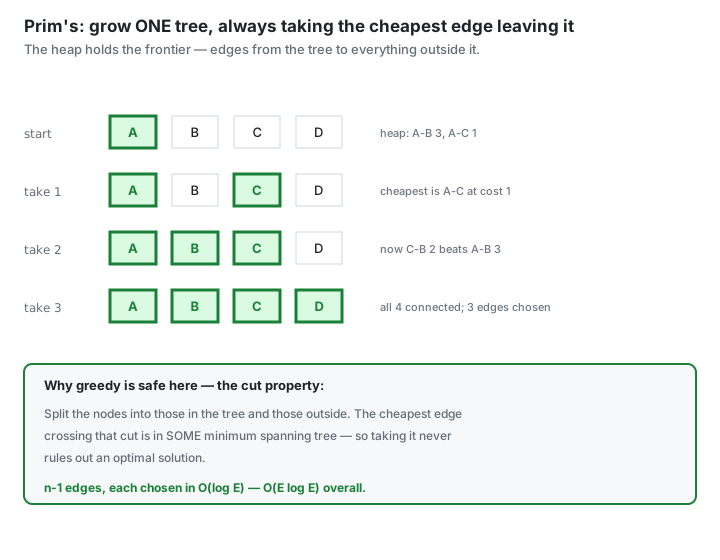
Both are correct by the cut property: the cheapest edge crossing any partition of the nodes belongs to some MST, so the greedy can never rule out an optimum.
The traps
| Trap | Symptom |
|---|---|
| Greedy smallest-next itinerary (Q1) | Strands tickets; naive greedy is almost right |
ArrayList.add(0, x) for the route (Q1) | O(E²) instead of O(E log E) |
| Kruskal's on a complete graph (Q2) | 500,000 edge objects built and sorted |
| BFS on weighted edges (Q3) | Fewest hops ≠ cheapest |
Arithmetic on Integer.MAX_VALUE (Q3, Q6) | Overflows negative; looks like a bargain |
| Taking more than the first differing char (Q5) | Invents constraints; false cycles |
| Missing the prefix check (Q5) | ["abc","ab"] returns a plausible order |
List instead of Set for adjacency (Q5) | Double-counted in-degree; letter never released |
| Plain Dijkstra with a hop cap (Q6) | Wrong answer, not slow |
| Relaxing in place (Q6) | Silently exceeds the hop budget |
k rounds instead of k + 1 (Q6) | Off by one stop |
Verification
Every snippet compiled and cross-checked against an independent implementation — 1,800+ randomized cases:
- Q1 against a backtracking reference on randomly generated Eulerian graphs
- Q2 across three implementations — array Prim's, heap Prim's, and Kruskal's
- Q3 Dijkstra against Bellman-Ford
- Q4 max-Dijkstra against binary search on the answer
- Q5 verified semantically: every derived alphabet order was re-checked by re-sorting the input words under it and confirming they come out in the given sequence
- Q6 against a depth-capped DFS reference
One deliberately-broken variant confirms the headline trap: relaxing in place rather than from a snapshot returns 200 for a k = 0 query whose answer is 500.