Cheapest Flights Within K Stops
1. Problem & Core Objective
Given n cities, a list of flights [from, to, price], a src, a dst, and an integer k, return the cheapest price from src to dst using at most k stops. Return -1 if no such route exists.
n = 4, flights = [[0,1,100],[1,2,100],[2,0,100],[1,3,600],[2,3,200]]
src = 0, dst = 3, k = 1   →  700      (0→1→3)
same with k = 2           →  400      (0→1→2→3 = 100+100+200)
Constraints: 1 <= n <= 100 · 0 <= flights.length <= n(n−1)/2 · 1 <= price <= 10^4 · 0 <= k < n
What's actually being tested: that the hop limit breaks Dijkstra's core invariant. Dijkstra finalises a node on its first pop; with a stop cap, a pricier route using fewer hops may still be needed later. Bellman-Ford fixes it by bounding the rounds rather than the costs — and the round count is exactly k + 1.
2. First-Principles Thought Process
Why Dijkstra alone is wrong
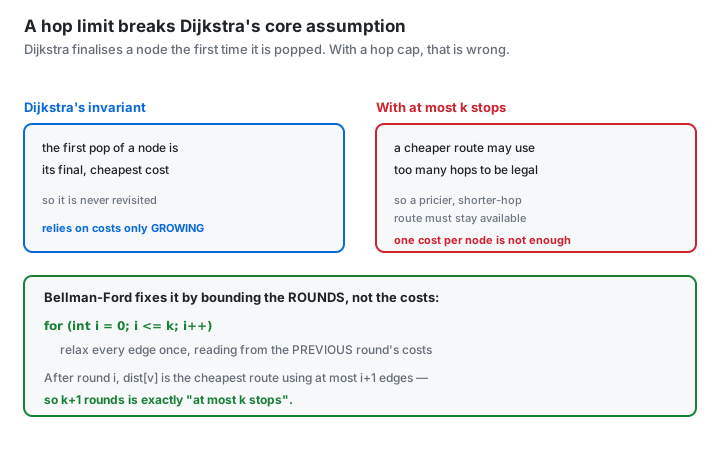
Dijkstra's correctness rests on: the first time a node is popped, its cost is final. That holds because costs only grow as paths extend.
With a hop limit, a cheaper route to a node may use too many hops to be legal for continuing onward. So a more expensive route with fewer hops must remain available — and a single "best cost per node" can't represent both.
Concretely: reaching city X for 100 in 3 hops and for 300 in 1 hop. If the budget allows only one more hop, the 300 route is the useful one, but Dijkstra would have discarded it.
The fix: count rounds, not costs
Bellman-Ford relaxes every edge, once per round. After round i, dist[v] is the cheapest route to v using at most i edges.
"At most k stops" means at most k + 1 flights — a stop is an intermediate city, so 1 stop is 2 flights. So run k + 1 rounds.
That's the whole algorithm: the round count directly encodes the constraint.
The critical detail: read from the previous round
Within a round, every relaxation must read the previous round's distances. If a relaxation reads a value written earlier in the same round, a path could use two edges in one round — silently exceeding the hop budget.
int[] next = dist.clone();                 // write here
for (int[] f : flights)
    next[f[1]] = Math.min(next[f[1]], dist[f[0]] + f[2]);   // read from dist
dist = next;
Forgetting the clone is the classic bug, and it fails silently — producing a cheaper answer that uses too many stops.
Why k + 1 and not k
k stops means k intermediate cities, so k + 1 edges. With k = 1, 0 → 1 → 3 uses one stop and two flights. Off-by-one here is the other common error.
3. Solution Paths
Approach 1 — DFS over all paths with a depth cap (brute force)
public int findCheapestPrice(int n, int[][] flights, int src, int dst, int k) {
    Map<Integer, List<int[]>> adj = new HashMap<>();
    for (int[] f : flights)
        adj.computeIfAbsent(f[0], x -> new ArrayList<>()).add(new int[]{f[1], f[2]});

    return dfs(adj, src, dst, k + 1, new HashSet<>());
}

private int dfs(Map<Integer, List<int[]>> adj, int at, int dst, int edgesLeft,
                Set<Integer> onPath) {
    if (at == dst) return 0;
    if (edgesLeft == 0) return Integer.MAX_VALUE;

    int best = Integer.MAX_VALUE;
    onPath.add(at);
    for (int[] f : adj.getOrDefault(at, List.of())) {
        if (onPath.contains(f[0])) continue;                  // avoid cycles
        int sub = dfs(adj, f[0], dst, edgesLeft - 1, onPath);
        if (sub != Integer.MAX_VALUE) best = Math.min(best, f[1] + sub);
    }
    onPath.remove(at);
    return best;
}- Time
O(n^k)· SpaceO(k)
Counter-questions on this approach
⭐ "Why is this exponential?"
It explores every path of length up to
k + 1independently. With branching factor up tonand depthk + 1, that'sO(n^k)— atn = 100andk = 99it's unimaginable.And it recomputes heavily: the cheapest route from city
Xwith 3 hops remaining is calculated afresh for every way of arriving atX.
⭐ "Could memoisation fix it?"
Yes, and that's the bridge to the right answer. Memoise on
(city, edgesLeft)— there aren × (k+1)such states, and each doesO(edges from that city)work. That givesO(k · E), which is exactly Bellman-Ford's complexity.So the DP and Bellman-Ford are the same computation, one top-down and one bottom-up. Worth saying, because it shows Bellman-Ford isn't an unrelated trick.
"Why the onPath cycle guard?"
Without it, a cycle like
0→1→2→0could be traversed repeatedly. The depth cap does bound it, but the guard prunes obviously-useless revisits.Note that with all-positive prices a cycle never helps, so excluding them costs nothing. With negative prices it would be wrong to exclude them — but then the problem changes entirely.
Approach 2 — Bellman-Ford, k + 1 rounds (optimal)
public int findCheapestPrice(int n, int[][] flights, int src, int dst, int k) {
    int[] dist = new int[n];
    Arrays.fill(dist, Integer.MAX_VALUE);
    dist[src] = 0;

    for (int round = 0; round <= k; round++) {          // k+1 rounds = at most k+1 flights
        int[] next = dist.clone();                       // snapshot the PREVIOUS round

        for (int[] f : flights) {
            int from = f[0], to = f[1], price = f[2];
            if (dist[from] == Integer.MAX_VALUE) continue;      // unreached — skip
            next[to] = Math.min(next[to], dist[from] + price);  // read dist, write next
        }
        dist = next;
    }

    return dist[dst] == Integer.MAX_VALUE ? -1 : dist[dst];
}
Trace — n = 4, flights as above, src = 0, dst = 3, k = 1:
| Round | dist at start | Relaxations | dist after |
|---|---|---|---|
| 0 | [0, ∞, ∞, ∞] | 0→1 gives 100 | [0, 100, ∞, ∞] |
| 1 | [0, 100, ∞, ∞] | 1→2 gives 200, 1→3 gives 700 | [0, 100, 200, 700] |
Two rounds (k + 1 = 2), answer dist[3] = 700 ✓
With k = 2 a third round runs. dist[2] is 200 after round 1 (via 0→1→2), so relaxing 2→3 gives min(700, 200 + 200) = 400 — the cheaper three-flight route becomes legal once the budget allows two stops.
That contrast is the whole problem: the same graph answers 700 at k = 1 and 400 at k = 2, so the hop budget genuinely changes which route is optimal.
- Time
O(k · E)· SpaceO(n)
Counter-questions on this approach
⭐ "Why k + 1 rounds rather than k?"
A "stop" is an intermediate city, so
kstops meansk + 1flights. Withk = 1, the route0 → 1 → 3has one stop and two edges.After round
i,dist[v]holds the cheapest route using at mosti + 1edges. Sok + 1rounds gives at mostk + 1edges, which is exactlykstops.Getting this off by one is the single most common error, and it fails quietly — returning the answer for
k − 1ork + 1stops.
⭐ "Why clone dist each round? What breaks without it?"
Without the clone, a relaxation can read a value written earlier in the same round, letting a path use two edges in one round. The hop budget is then silently exceeded.
Concretely with
k = 0(direct flights only) and flights0→1then1→2in that order: relaxing in place would setdist[1]and then immediately use it to setdist[2], reporting a two-flight route as reachable with zero stops.Reading from the snapshot guarantees each round adds exactly one edge. This is the detail that makes it a bounded-hop algorithm rather than plain Bellman-Ford.
⭐ "Why the dist[from] == MAX_VALUE guard?"
Because
MAX_VALUE + priceoverflows to a large negative number, which would then look like an excellent price and corrupt everything downstream.It's the same sentinel-arithmetic discipline as elsewhere:
Integer.MAX_VALUEas infinity is safe only if you never add to it.
"How does this compare to Dijkstra with a hop count in the state?"
That also works: make the heap entries
(cost, city, stopsUsed)and allow a city to be visited multiple times with different stop counts. It'sO(E · k log(E · k))— correct, but more machinery and a subtler termination argument.Bellman-Ford is
O(k · E)=99 × 4950≈5 × 10^5here, simpler, and the round count encodes the constraint directly. I'd write Bellman-Ford and mention the Dijkstra variant.
"Does the order of the flights array matter?"
Not with the clone — every relaxation reads the same snapshot, so the result is order-independent. Without the clone it would matter, which is another symptom of the same bug.
"What if src == dst?"
dist[src] = 0and no relaxation lowers it, so the answer is 0. Correct — you're already there.
Comparison
| Approach | Time | Handles the hop cap | Notes |
|---|---|---|---|
| DFS all paths | O(n^k) | via a depth cap | Exponential; memoises into Bellman-Ford |
| Plain Dijkstra | O(E log V) | no | Finalises too early |
| Dijkstra + stops in state | O(E·k log(E·k)) | yes | Correct; more machinery |
Bellman-Ford, k+1 rounds | O(k · E) | yes | The answer |
4. Why the Optimal Wins
Plain Dijkstra is wrong, not slow — its finality invariant assumes a cheaper route is always preferable, which the hop limit breaks.
The DFS is correct but exponential, and memoising it on (city, hopsLeft) produces exactly Bellman-Ford's state space.
Bellman-Ford bounds the rounds instead of the costs, so the constraint is expressed structurally rather than checked. O(k · E) with an O(n) array.
The framing worth keeping:
A hop limit breaks Dijkstra, because a pricier short route can outlive a cheaper long one. Bellman-Ford bounds the ROUNDS instead —
k + 1of them, each reading the previous round's snapshot so exactly one edge is added per round.
5. Java Prerequisites
Bellman-Ford with a bounded round count
for (int round = 0; round <= k; round++) {
    int[] next = dist.clone();                       // read from dist, write to next
    for (int[] f : flights)
        if (dist[f[0]] != Integer.MAX_VALUE)
            next[f[1]] = Math.min(next[f[1]], dist[f[0]] + f[2]);
    dist = next;
}
int[].clone() is a shallow copy — fine for primitives, and O(n) per round.
Infinity discipline — guard before adding to Integer.MAX_VALUE, or it overflows negative.
Stops vs edges — k stops = k + 1 edges = k + 1 rounds.
6. Interview Communication Guide
Clarifying questions: Does k count intermediate stops or flights (stops — so k + 1 flights; confirm, it's the off-by-one)? Are prices positive (yes)? Can there be cycles (yes)? What if src == dst (0)? Multiple flights between the same pair (possible; relaxation handles it)?
The pitch
"The instinct is Dijkstra, and it's wrong here — worth explaining why.
Dijkstra finalises a node the first time it's popped, which is valid because costs only grow as paths extend. But with a stop limit, a cheaper route to a city might use too many hops to continue onward, so a pricier route with fewer hops must stay available. One best-cost-per-node can't represent both.
Bellman-Ford fixes it by bounding the rounds rather than the costs. Each round relaxes every edge once, and after round
i,dist[v]is the cheapest route using at mosti + 1edges.Since
kstops meansk + 1flights — a stop is an intermediate city — I runk + 1rounds. That off-by-one is the first thing I'd double-check.The critical implementation detail: each round must read the previous round's distances. I clone the array, read from the old one, and write to the new one. Without that, a relaxation could read a value written earlier in the same round, letting a path use two edges in one round and silently exceeding the hop budget. With
k = 0and flights0→1then1→2in that order, relaxing in place would report a two-flight route as reachable with zero stops.I also guard against relaxing from an unreached city, since
Integer.MAX_VALUE + priceoverflows negative and would look like a bargain.
O(k · E)— about5 × 10^5at these limits — withO(n)space.There's a Dijkstra variant that works: put the stop count in the heap state so a city can be visited at several hop counts. Also correct, but more machinery and a subtler termination argument."
Edge cases to volunteer:
| Input | Expected | Tests |
|---|---|---|
src == dst | 0 | Already there |
No route within k | -1 | Stays at infinity |
k = 0 | direct flights only | Where the clone bug shows immediately |
| A cheaper route needing more stops | the pricier legal one | Where Dijkstra fails |
| Cycle in the graph | handled | Rounds bound the path length |
k = n − 1 | unrestricted | Equivalent to plain shortest path |
Name the k = 0 case and the cheaper-but-too-long route. The first exposes a missing clone instantly; the second is precisely the scenario Dijkstra gets wrong.
7. Follow-Up Questions — Modified Constraints
⭐ "Return the route, not just the price."
Track a
parent[]per round — but since a city's best predecessor differs by round, you needparent[round][city], which isO(k · n)space. Then walk back from(k+1, dst). More bookkeeping than the cost alone.
⭐ "What if prices could be negative?"
Bellman-Ford still works for bounded hops — the round structure doesn't assume positivity. But a negative cycle would make the unbounded problem undefined; with a hop cap it stays well-defined, since you can only go around so many times. That's a nice property of the bounded version worth mentioning.
"What if k were unbounded?"
Then it's plain shortest path and Dijkstra becomes correct again, at
O(E log V)— much better than Bellman-Ford'sO(V · E). The hop limit is precisely what rules Dijkstra out.
"Find the cheapest route with at most k stops for every destination."
This already computes it —
dist[]holds the answer for every city, not justdst. The single-destination framing hides that Bellman-Ford is inherently single-source-all-destinations.
"What if there were 10^5 cities and 10^6 flights?"
O(k · E)withkup to10^5would be10^11— infeasible. You'd need the Dijkstra-with-state variant, pruning aggressively on(city, stops)pairs already seen at a lower cost.
"What if each flight also had a duration and you wanted the fastest within a price budget?"
Two-dimensional optimisation — minimise time subject to a cost cap. That's a constrained shortest path, which is NP-hard in general; you'd use a Lagrangian relaxation or a DP over discretised budget levels.