1-D Dynamic Programming
12 questions. Every one is the same pipeline; what varies is the recurrence, the combiner, and whether the state can be compressed.
The two properties that license DP
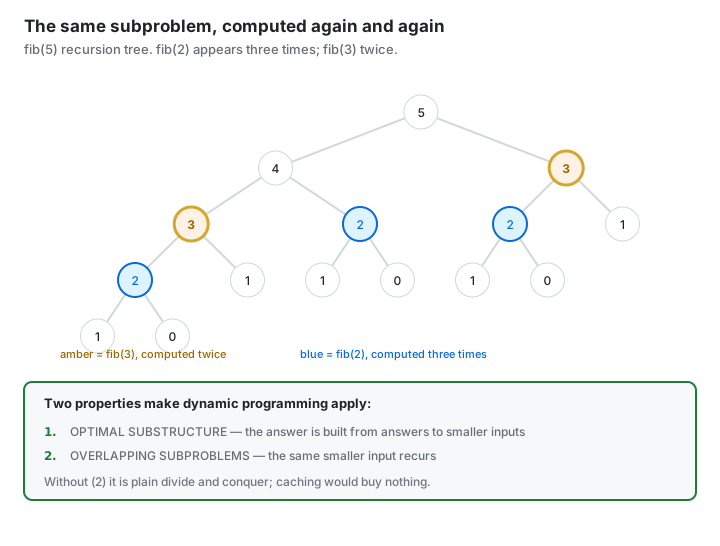
- Optimal substructure — the answer is built from answers to smaller inputs
- Overlapping subproblems — the same smaller input recurs
Without (2) it's plain divide and conquer and caching buys nothing. The signal is exponentially many calls over polynomially many distinct inputs.
The four stages
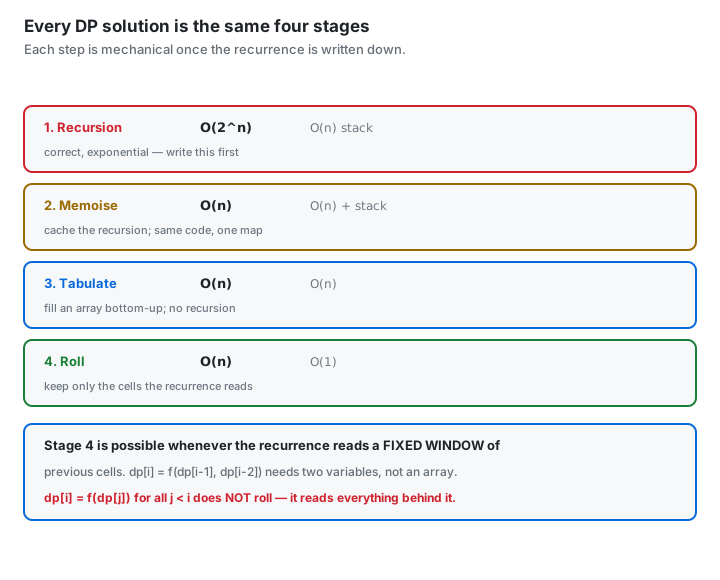
Write the recursion first — it's obviously correct. Then memoise, tabulate, and roll. Each step is mechanical once the recurrence exists.
The combiner is chosen by the question
The structure comes from the allowed moves; the combiner comes from what's being asked. They're independent choices.
| Goal | Combiner | Questions |
|---|---|---|
| count the ways | + | 1, 7 |
| best / cheapest | min / max | 2, 3, 4, 8, 9, 11, 12 |
| does one exist | || | 10, 12 |
Min Cost Climbing Stairs is Climbing Stairs with min for + — same recurrence, one substitution.
When you CAN roll to O(1) space
Only when the recurrence reads a fixed window of previous cells.
| Recurrence | Rolls? | Questions |
|---|---|---|
dp[i] = f(dp[i-1], dp[i-2]) | yes — two variables | 1, 2, 3, 4, 7, 9 |
dp[i] = f(dp[j]) for a range of j | no — array required | 8, 10, 11, 12 |
Word Break, Coin Change and LIS are the counterexamples: each reads many earlier cells, so nothing can be discarded.
Ascending vs descending — knapsack's whole distinction
| Loop direction | Meaning | Question |
|---|---|---|
| ascending | an item may be reused — unbounded knapsack | 8 (Coin Change) |
| descending | each item used once — 0/1 knapsack | 12 (Partition Equal Subset Sum) |
Descending means dp[s - n] still holds the value from before this item was considered. Verified: the ascending variant of question 12 disagreed with the correct answer on 44 of 400 random inputs.
Where DP is NOT the best answer
Question 5. The isPal[i][j] table is O(n²) time and space; expand-around-centre is O(n²) time and O(1) space. The table earns its place only when queried repeatedly — which is Palindrome Partitioning, not this.
LIS: the reframe that changes what's indexed
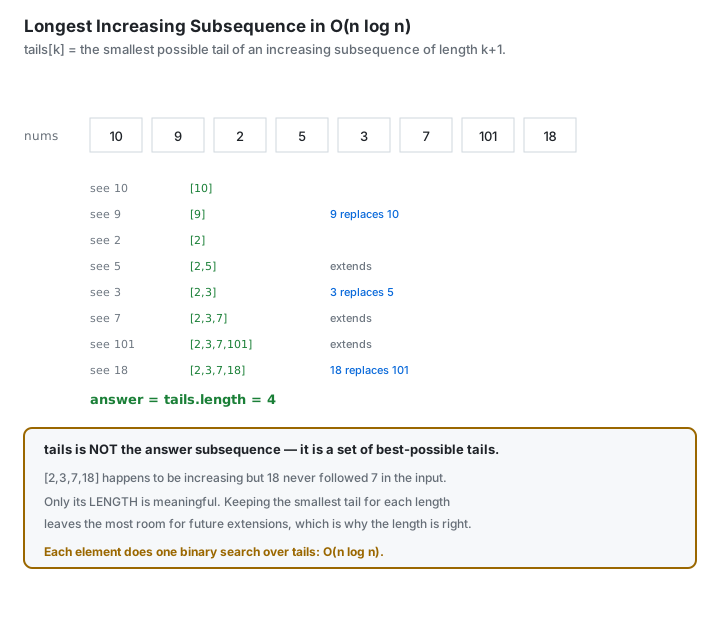
The O(n²) DP indexes by position. The patience method indexes by length — tails[k] is the smallest tail of any increasing subsequence of length k+1. That array is sorted by construction, so the scan becomes a binary search.
tails is not the answer subsequence. On the example it ends as [2,3,7,18], but 18 comes after 101 in the input. Only its length is meaningful.
The traps
| Trap | Symptom |
|---|---|
memo[n] != 0 when 0 is a valid answer (Q1) | Infinite recomputation |
Returning dp[n-1] instead of dp[n] (Q2) | Answers a different question |
dp[1] = nums[1] instead of max (Q3) | [5,1] returns 1 |
| Forgetting the circular case split (Q4) | [5,1,1,5] returns 10 instead of 6 |
| Only odd-length centres (Q5, Q6) | "cbbd" misses "bb" |
| Missing the leading-zero guard (Q7) | "06" returns 1 instead of 0 |
two <= 26 without >= 10 (Q7) | "06" counted as F |
Integer.MAX_VALUE sentinel (Q8) | Overflows to MIN_VALUE; wins every min |
| Greedy coin selection (Q8) | [1,3,4] amount 6 gives 3, not 2 |
| Not snapshotting the old max (Q9) | [-1,-2,-3] returns 12 — an impossible value |
boolean[] memo when false is an answer (Q10) | Recomputes every false |
dp[n-1] instead of max(dp) (Q11) | [1,2,3,0] returns 1 |
| Missing the odd-total check (Q12) | [1,2,3,5] returns true |
| Ascending loop in 0/1 knapsack (Q12) | Items reused |
Sentinels need a domain check
Three questions overload a value to mean "not computed" or "unreachable", and each works only because the sentinel is provably outside the answer range:
| Question | Sentinel | Safe because |
|---|---|---|
| Climbing Stairs | 0 | The count is always >= 1 |
| Coin Change | amount + 1 | Worst case is amount coins — and it survives + 1 |
| Word Break | null (Boolean[]) | false is a legitimate answer |
Integer.MAX_VALUE fails the Coin Change case precisely because the recurrence adds to it.
Verification
Every snippet compiled and cross-checked against an independent implementation — 4,000+ randomized cases:
- Q1–Q3, Q7, Q10, Q12 against their own exponential recursions
- Q4 against circular subset enumeration with a wraparound adjacency check
- Q5, Q6, Q9 against all-substrings / all-subarrays brute force
- Q6's run-of-
kformulak(k+1)/2verified independently atk = 100 - Q11 across both the
O(n²)andO(n log n)implementations
Five deliberately-broken variants confirm the traps:
- omitting Q7's leading-zero guard returns 1 for
"06" - greedy on
[1,3,4]with amount 6 gives 3 where the DP gives 2 - omitting Q9's max snapshot returns 12 for
[-1,-2,-3]— a value no subarray achieves - omitting Q12's odd-total check returns true for
[1,2,3,5] - Q12's ascending loop disagreed on 44 of 400 random inputs