Longest Increasing Subsequence
1. Problem & Core Objective
Return the length of the longest strictly increasing subsequence. A subsequence need not be contiguous.
nums = [10,9,2,5,3,7,101,18]   →  4      [2,3,7,18] or [2,3,7,101]
nums = [0,1,0,3,2,3]           →  4      [0,1,2,3]
nums = [7,7,7,7,7]             →  1      strictly increasing
Constraints: 1 <= nums.length <= 2500 · -10^4 <= nums[i] <= 10^4
What's actually being tested: the O(n²) DP is expected; the O(n log n) patience solution is the differentiator. And the crucial subtlety there — the maintained array is not the answer subsequence, only its length is meaningful.
2. First-Principles Thought Process
The O(n²) recurrence
dp[i] = the length of the longest increasing subsequence ending at index i.
To extend to i, the previous element must be at some j < i with nums[j] < nums[i]:
dp[i] = 1 + max over j < i with nums[j] < nums[i] of dp[j]with dp[i] = 1 if no such j exists (the element alone).
The answer is max(dp), not dp[n−1] — the longest subsequence needn't end at the last element. That's a real trap: on [1,2,3,0], dp[3] = 1 but the answer is 3.
Why this can't be rolled
dp[i] reads every dp[j] for j < i. Unbounded lookback — the array is required, and O(n²) is the honest bound for this formulation.
Same counterexample as Word Break, and the clearest contrast with the fixed-window recurrences earlier in this section.
The O(n log n) reframe
Maintain tails, where tails[k] is the smallest possible tail value of any increasing subsequence of length k+1.
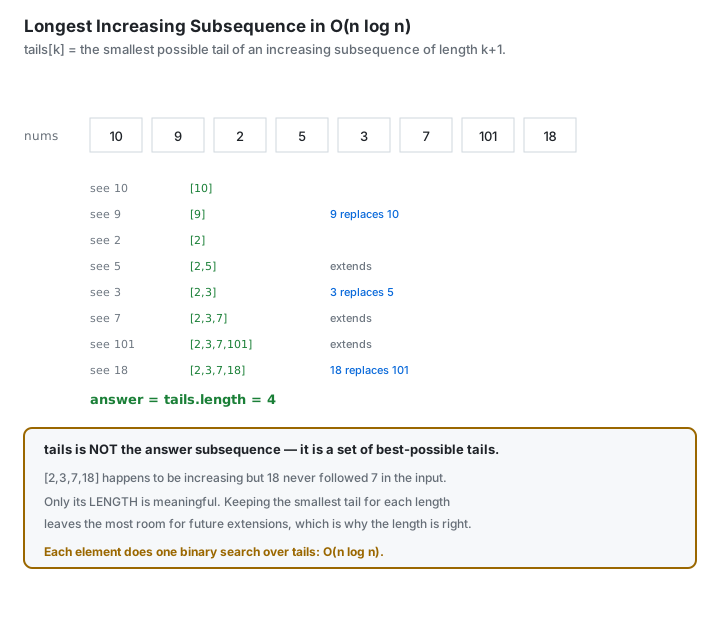
For each element x:
- binary search for the first entry
>= x - if none, append —
xextends the longest subsequence found so far - otherwise replace that entry with
x— a subsequence of that length now ends smaller
The answer is tails.length.
Why keeping the smallest tail is correct
A smaller tail leaves more room for future elements to extend it. If two increasing subsequences have the same length, the one ending smaller is at least as extensible — never worse.
So replacing is safe: it never loses a possible future extension, and it may gain some.
The trap: tails is not the answer
After processing [10,9,2,5,3,7,101,18], tails is [2,3,7,18] — which is increasing and is length 4. But 18 never followed 7 in the input; the real subsequences are [2,3,7,101] and [2,5,7,101].
tails is a bookkeeping array of best-possible tails, not a subsequence. Only its length is meaningful. Reporting it as the answer subsequence would be wrong.
3. Solution Paths
Approach 1 — Try every subsequence (brute force)
public int lengthOfLIS(int[] nums) {
    return lis(nums, 0, Integer.MIN_VALUE);
}

private int lis(int[] nums, int i, int prev) {
    if (i == nums.length) return 0;
    int skip = lis(nums, i + 1, prev);                        // don't take nums[i]
    int take = 0;
    if (nums[i] > prev) take = 1 + lis(nums, i + 1, nums[i]); // take it
    return Math.max(take, skip);
}- Time
O(2^n)· SpaceO(n)stack
Counter-questions on this approach
⭐ "Why is this hard to memoise directly?"
The state is
(i, prev), andprevis a value rather than an index — so the state space isntimes the value range, notn².You can memoise on
(i, prevIndex)instead, which givesO(n²)states. That's the bridge to theO(n²)DP — and it's why the standard formulation indexes by "ending ati" rather than carrying a previous value.
⭐ "What does the take-or-skip shape tell you?"
That it's the same family as House Robber — two branches per element. The difference is that the "take" branch is conditional on
nums[i] > prev, which is what makes the state need more than just the index.
Approach 2 — O(n²) DP
public int lengthOfLIS(int[] nums) {
    int n = nums.length;
    int[] dp = new int[n];
    Arrays.fill(dp, 1);                                // each element alone is length 1
    int best = 1;

    for (int i = 1; i < n; i++) {
        for (int j = 0; j < i; j++)
            if (nums[j] < nums[i]) dp[i] = Math.max(dp[i], dp[j] + 1);
        best = Math.max(best, dp[i]);                  // the answer may end anywhere
    }
    return best;
}
Trace — nums = [10,9,2,5,3,7,101,18]:
i | nums[i] | Valid j (smaller values) | dp[i] |
|---|---|---|---|
| 0 | 10 | — | 1 |
| 1 | 9 | — | 1 |
| 2 | 2 | — | 1 |
| 3 | 5 | j=2 (2) | 2 |
| 4 | 3 | j=2 (2) | 2 |
| 5 | 7 | j=2,3,4 → best dp[3] or dp[4] = 2 | 3 |
| 6 | 101 | all → best dp[5] = 3 | 4 |
| 7 | 18 | j=2,3,4,5 → best dp[5] = 3 | 4 |
max(dp) = 4 ✓
- Time
O(n²)=6.25 × 10^6· SpaceO(n)
Counter-questions on this approach
⭐ "Why is the answer max(dp) rather than dp[n−1]?"
Because
dp[i]is the longest subsequence ending ati, and the overall longest needn't end at the last element.On
[1,2,3,0],dp = [1,2,3,1]— the last element is smallest, sodp[3] = 1. Returningdp[n−1]gives 1 instead of 3.This is the same state-definition issue as in House Robber, in reverse: there
dp[i]meant "best over the prefix" so the last cell was the answer; here it means "best ending ati" so it isn't.
⭐ "Why nums[j] < nums[i] and not <=?"
The problem says strictly increasing. With
<=,[7,7,7,7,7]would report 5 instead of 1.If the problem allowed non-decreasing, this single character would change — and in the binary-search version it changes which search variant you use, which is the subtler consequence.
"Why Arrays.fill(dp, 1)?"
Every element is an increasing subsequence of length 1 on its own. Without it the defaults are 0, and an element with no smaller predecessor would report 0 instead of 1.
"Is O(n²) acceptable here?"
At
n = 2500it's6.25 × 10^6— comfortably fast. So theO(n log n)version isn't required by the constraints; it's the differentiator if asked to do better.
Approach 3 — Patience sorting with binary search (optimal)
public int lengthOfLIS(int[] nums) {
    List<Integer> tails = new ArrayList<>();

    for (int x : nums) {
        int pos = lowerBound(tails, x);              // first index with tails[idx] >= x
        if (pos == tails.size()) tails.add(x);       // x extends the longest so far
        else tails.set(pos, x);                      // a length-(pos+1) run now ends smaller
    }
    return tails.size();
}

private int lowerBound(List<Integer> tails, int target) {
    int lo = 0, hi = tails.size();
    while (lo < hi) {
        int mid = lo + (hi - lo) / 2;
        if (tails.get(mid) < target) lo = mid + 1;
        else                          hi = mid;
    }
    return lo;
}
Trace — nums = [10,9,2,5,3,7,101,18]:
| Element | tails before | Action | tails after |
|---|---|---|---|
| 10 | [] | append | [10] |
| 9 | [10] | replace index 0 | [9] |
| 2 | [9] | replace index 0 | [2] |
| 5 | [2] | append | [2,5] |
| 3 | [2,5] | replace index 1 | [2,3] |
| 7 | [2,3] | append | [2,3,7] |
| 101 | [2,3,7] | append | [2,3,7,101] |
| 18 | [2,3,7,101] | replace index 3 | [2,3,7,18] |
Length 4 ✓ — verified against the O(n²) DP.
- Time
O(n log n)· SpaceO(n)
Counter-questions on this approach
⭐ "What does tails[k] actually mean?"
The smallest possible tail value among all increasing subsequences of length
k+1seen so far.Not "the tail of the best subsequence" — the smallest achievable tail at that length. That's why replacement is correct: finding a length-
k+1run ending smaller strictly improves future extensibility.
⭐ "Why is replacing safe? Doesn't it destroy a subsequence?"
It doesn't destroy anything real —
tailswas never storing actual subsequences.The argument: if two increasing subsequences have the same length, the one ending in a smaller value can be extended by strictly more future elements. So keeping the smaller tail never loses a possible extension and may gain some.
The length recorded at each index stays achievable; only the recorded tail improves.
⭐ "Is tails itself a valid answer subsequence?"
No, and this is the trap. After the trace above,
tails = [2,3,7,18]— increasing and of the right length, but 18 appears before 101 intailswhile appearing after it in the input. The real subsequences of length 4 are[2,3,7,101]and[2,5,7,101].So
tailsis bookkeeping, not an answer. Onlytails.size()is meaningful.To recover an actual subsequence you'd record, for each element, the
tailsindex it landed at plus a back-pointer — then walk back from the final append.
⭐ "Why lowerBound (first >= x) rather than upperBound (first > x)?"
Because the requirement is strictly increasing.
lowerBoundfinds the first entry>= xand replaces it — so an equal value is replaced rather than appended, and duplicates never extend the length.On
[7,7,7,7,7], every 7 replacestails[0]and the answer stays 1 ✓.If the problem allowed non-decreasing subsequences, you'd use
upperBoundinstead, so an equal value appends. That one-function swap is the entire difference, and it's easy to get backwards.
"Why hi = tails.size() rather than size() - 1?"
Because
pos == tails.size()is a meaningful outcome — it means "xis larger than every tail, so append". The search space is the half-open range[0, size], which is thelo < hi/hi = midconvention from Section 5.
"Could Collections.binarySearch be used instead?"
Yes, with care: it returns
-(insertionPoint) - 1when absent, so you'd convert. And for a present element it may return any matching index, which breaks the strict-vs-non-strict distinction. Writing the bound explicitly is clearer and avoids that ambiguity.
Comparison
| Approach | Time | Space | Notes |
|---|---|---|---|
| Recursion | O(2^n) | O(n) stack | State is (i, prev) |
O(n²) DP | O(n²) = 6.25 × 10^6 | O(n) | Expected answer; passes easily |
| Patience + binary search | O(n log n) | O(n) | The differentiator |
4. Why the Optimal Wins
The O(n²) DP asks, for each element, "which earlier element should precede me?" — scanning all of them.
The patience method reframes it: instead of tracking the best subsequence ending at each index, track the best tail for each achievable length. That array is sorted by construction, so the search becomes binary rather than linear.
O(n²) → O(n log n), from changing what's being indexed — lengths rather than positions.
The framing worth keeping:
tails[k]is the smallest tail of any increasing subsequence of lengthk+1. Smaller tails extend more easily, so replacing is always safe — buttailsis NOT the answer subsequence, only its length is.
5. Java Prerequisites
The O(n²) recurrence
Arrays.fill(dp, 1);
for (int j = 0; j < i; j++)
    if (nums[j] < nums[i]) dp[i] = Math.max(dp[i], dp[j] + 1);
best = Math.max(best, dp[i]);          // the answer may end anywhere
Lower bound — first index with tails[idx] >= target:
int lo = 0, hi = tails.size();         // half-open, so pos == size means "append"
while (lo < hi) { int mid = lo + (hi-lo)/2; if (tails.get(mid) < target) lo = mid+1; else hi = mid; }
Strict vs non-strict — lowerBound for strictly increasing, upperBound for non-decreasing. One function swap.
Collections.binarySearch is awkward here — it returns an encoded insertion point when absent and an arbitrary match when present.
6. Interview Communication Guide
Clarifying questions: Strictly increasing or non-decreasing (strictly — it decides which binary-search bound)? Subsequence or subarray (subsequence — non-contiguous)? Return the length or the sequence (length; recovering the sequence is extra work)? Maximum n (2500, so O(n²) passes)?
The pitch
"The standard DP is
dp[i]= the longest increasing subsequence ending at indexi. To extend toi, the previous element is anyj < iwith a smaller value, sodp[i] = 1 + max of those dp[j], defaulting to 1.The answer is
max(dp), notdp[n−1]— the longest subsequence needn't end at the last element. On[1,2,3,0]the last cell is 1 while the answer is 3.That's
O(n²)=6.25 × 10^6here, which passes comfortably. It also can't be rolled toO(1)space, becausedp[i]reads every earlier cell rather than a fixed window.If asked to do better, there's an
O(n log n)method. Maintain an arraytailswheretails[k]is the smallest possible tail of any increasing subsequence of lengthk+1. For each element, binary search for the first entry>= x: if there isn't one, append —xextends the longest run; otherwise replace it.Replacing is safe because a smaller tail is at least as extensible — if two subsequences have the same length, the one ending smaller can be continued by strictly more future elements. So it never loses an option.
The crucial subtlety:
tailsis not the answer subsequence. On the example it ends as[2,3,7,18], but 18 comes after 101 in the input, so that's not a real subsequence — the actual ones are[2,3,7,101]and[2,5,7,101]. Onlytails.size()is meaningful. Recovering an actual subsequence needs back-pointers.And the bound matters: I use lower bound — first entry
>= x— because the problem wants strictly increasing, so an equal value replaces rather than appends. On[7,7,7,7,7]that correctly gives 1. If non-decreasing were allowed, I'd use upper bound instead, and that's the whole difference."
Edge cases to volunteer:
| Input | Expected | Tests |
|---|---|---|
[1] | 1 | Single element |
[7,7,7,7,7] | 1 | Strictly increasing — lower bound |
[5,4,3,2,1] | 1 | Decreasing; every element replaces index 0 |
[1,2,3,0] | 3 | Answer is max(dp), not dp[n−1] |
[10,9,2,5,3,7,101,18] | 4 | The worked example |
| Strictly increasing input | n | Every element appends |
Name [7,7,7,7,7] and [1,2,3,0]. The first pins down strict-vs-non-strict; the second catches returning the last cell instead of the maximum.
7. Follow-Up Questions — Modified Constraints
⭐ "Return the actual subsequence, not just its length."
With the
O(n²)DP, track aprev[]index per element and walk back from the argmax. With the patience method it's harder: record for each element thetailsposition it occupied plus a pointer to the element then atposition − 1, then follow the chain back from the last append.Worth stating that the
O(n log n)version makes reconstruction genuinely fiddlier — the array it maintains isn't the answer.
⭐ "Count the number of longest increasing subsequences."
LeetCode 673. Keep a second array
count[i]alongsidedp[i], incrementing when an equal-length path is found and resetting when a longer one appears.O(n²). The patience method doesn't extend to counting cleanly.
"Allow non-decreasing subsequences."
Change
<to<=in theO(n²)DP, and swaplowerBoundforupperBoundin the patience version. One line either way, but in opposite-looking directions — worth deriving rather than memorising.
"Find the longest DECREASING subsequence."
Negate the values, or reverse the comparison. Same algorithm.
"What if n were 10^5?"
O(n²)is10^10— infeasible. TheO(n log n)version becomes necessary, which is the threshold where it stops being optional.
"Find the minimum number of increasing subsequences the array can be split into."
By Dilworth's theorem, that equals the length of the longest non-increasing subsequence. A pleasing result: one LIS-style computation answers a partitioning question.