Heap / Priority Queue
7 questions. A heap maintains one weak guarantee — parent before children — and that's exactly enough to expose an extreme in O(1) while costing only O(log n) to update.
The one idea
Sorting gives you complete order for O(n log n). If you only ever need the minimum (or the maximum), that's far more than you're paying for.
| Operation | Cost |
|---|---|
| See the extreme | O(1) |
| Insert | O(log n) |
| Remove the extreme | O(log n) |
| Find an arbitrary element | O(n) — there's no order to exploit |
That last row is the price. A heap is useless for lookup, and that's why removing a specific value is the recurring pain point in the follow-ups.
The inversion that trips everyone up
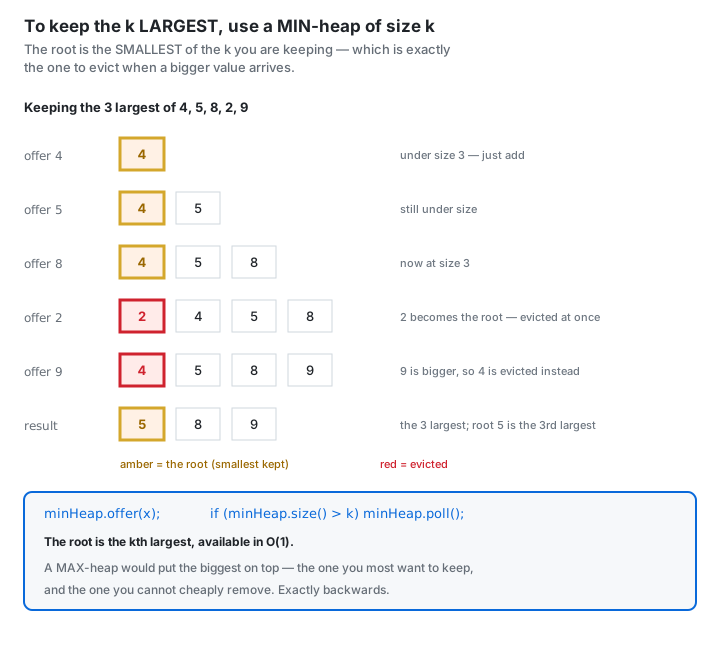
Min-heap for the
kLARGEST. Max-heap for thekSMALLEST.
The heap is always inverted relative to the wording, because the root is the eviction candidate, not the answer. Keeping the k largest means the thing to discard is the smallest of them — so that's what must sit at the root.
Questions 1, 3 and 4 are all this same move.
When a heap is NOT the answer
Two of the seven have better solutions, which is worth knowing before reaching for a PriorityQueue reflexively:
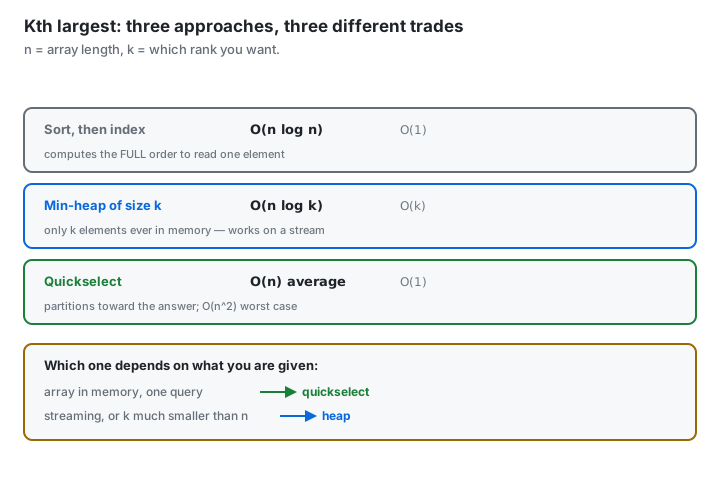
Question 4 — with the whole array in memory, quickselect is O(n) average versus the heap's O(n log k).
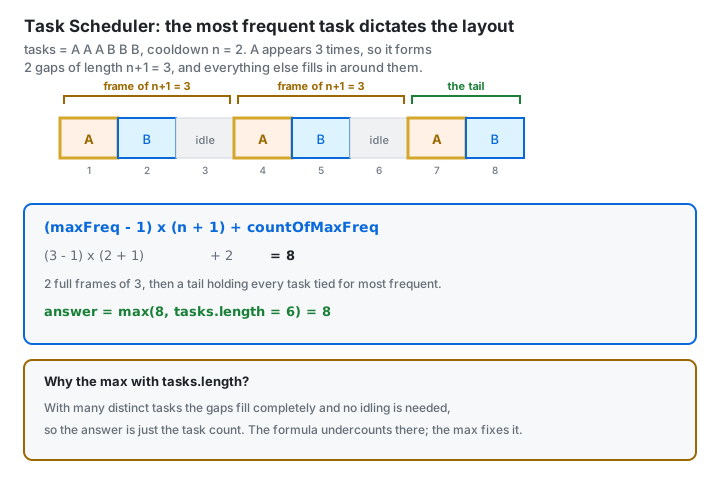
Question 5 — the greedy heap simulation is correct but does work proportional to the answer, which can dwarf the input. The frequency formula is O(n).
The heap wins when data streams, when k ≪ n, or when the collection changes between extractions.
Two heaps for the median
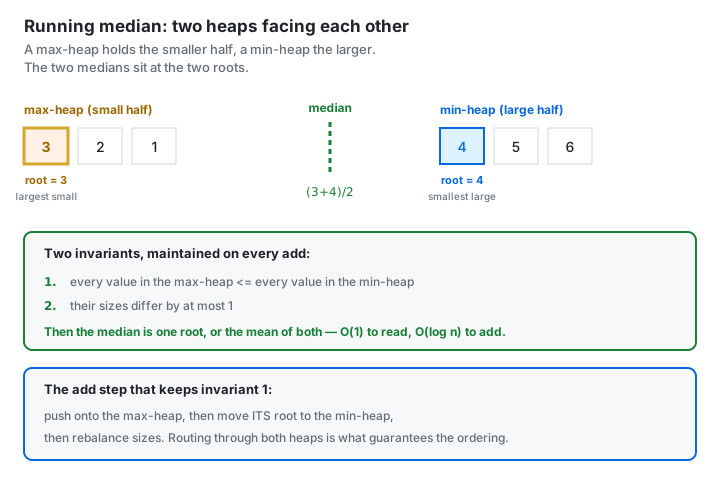
A heap exposes an extreme; the median is the element furthest from both extremes. Split the data at the median and each half's adjacent element becomes an extreme.
The add is three unconditional lines — offer to the max-heap, push its root across to the min-heap, then rebalance. The routing enforces the ordering, so there are no comparisons and no boundary cases. The order matters: rebalancing before transferring can break the invariant.
The traps
| Trap | Symptom |
|---|---|
| Max-heap for the k largest (Q1, Q4) | The element you need is buried at a leaf |
TreeSet instead of a heap (Q1) | Duplicates collapse — silently wrong rank |
| Pushing a zero stone (Q2) | A phantom stone can be returned as the answer |
!isEmpty() instead of size() > 1 (Q2) | poll() returns null → NPE on unboxing |
Computing √ (Q3) | Needless floating point; x² + y² orders identically |
k - 1 instead of n - k (Q4) | Plausible wrong answer, not a crash |
| Deterministic pivot (Q4) | O(n²) on sorted input — measured 595× worse |
Formula without max(tasks.length, …) (Q5) | Undercounts when the gaps overflow |
List instead of Set for follows (Q6) | Double-follow duplicates tweets in the feed |
| Forgetting self-inclusion (Q6) | Your own tweets silently vanish from your feed |
/ 2 instead of / 2.0 (Q7) | 1.5 truncates to 1.0 |
Java notes
new PriorityQueue<>()                              // min-heap (the default)
new PriorityQueue<>(Comparator.reverseOrder())     // max-heap
new PriorityQueue<>(existingCollection) // O(n) heapify — natural ordering only- Permits duplicates, forbids nulls. Duplicates matter for correct ranks.
(a, b) -> b - aoverflows. UseComparator.reverseOrder()orcomparingInt.reversed()reverses the whole chain, not just the last key.- Iterating a
PriorityQueueis not sorted — only repeatedpollis. remove(Object)isO(n). This is what makes deletion follow-ups hard; the standard fix is lazy deletion.
Verification
Every snippet compiled and cross-checked against an independent implementation — 3,000+ randomized cases:
- Q1 against a sort-everything reference, 400 streams × 25 adds
- Q2 against a re-sort-each-round reference, 504 cases
- Q3 across all three implementations, comparing distance multisets rather than point sets, since ties make the chosen points ambiguous
- Q4 across sort, heap and quickselect, 502 cases
- Q5 formula verified against the greedy simulation, 506 cases
- Q6 against a collect-and-sort reference, 300 traces × 60 mixed operations
- Q7 against a sort reference over random, ascending and descending streams — the last two exercise the rebalance in opposite directions
Four deliberately-broken variants confirm the traps:
- a
TreeSet-backed Q1 returns 3 instead of 5 for the stream5, 3, 5withk = 2 - the Q5 formula without the
maxreturns 7 instead of 10 onAAABCDEFGHwithn = 2 - Q7 with
/ 2returns 1.0 instead of 1.5 - a last-element pivot on a sorted array of 4,000 scans 8,001,999 elements to find the minimum versus 13,455 with a random pivot — and, notably, only 4,000 to find the maximum, so the worst case needs sorted input and an unlucky
k