Kth Largest Element in an Array
1. Problem & Core Objective
Return the k-th largest element in an unsorted array. This is the k-th largest in sorted order, not the k-th distinct element.
nums = [3,2,1,5,6,4], k = 2        →  5
nums = [3,2,3,1,2,4,5,5,6], k = 4  →  4      ← duplicates count separately
Can you solve it without sorting?
Constraints: 1 <= k <= nums.length <= 10^5 · -10^4 <= nums[i] <= 10^4
What's actually being tested: the same selection question as question 3, but now the problem explicitly asks you to beat sorting — so the expected answer is quickselect, with the heap as the streaming alternative. The duplicate clarification in the statement is also deliberate: it rules out deduplicating.
2. First-Principles Thought Process
Read the hint
"Without sorting" is the problem telling you O(n log n) isn't the target. Two things beat it:
- Heap of size
k—O(n log k), better wheneverk < n - Quickselect —
O(n)average, the intended answer
Why sorting is more than you need
Sorting computes the position of every element. You want the position of one. That's n log n work for a single answer.
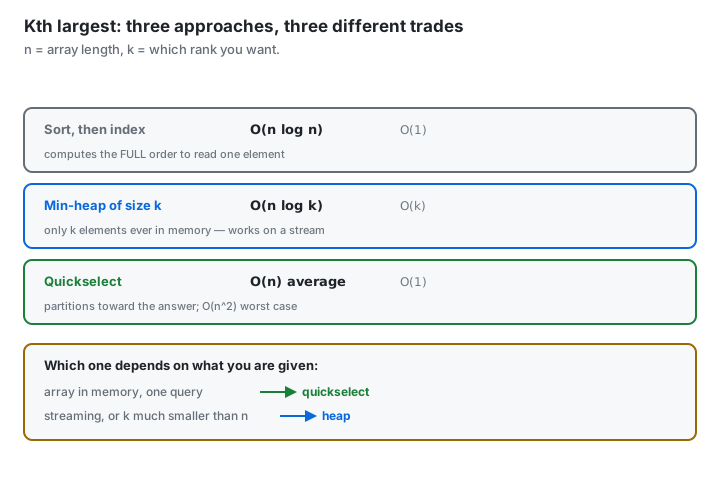
The heap, and its inversion
From question 1: to keep the k largest, use a min-heap of size k. Its root is the smallest of the kept set, which is both the k-th largest and the eviction candidate.
O(n log k) time, O(k) space.
Quickselect: partition toward the answer
Quicksort partitions around a pivot, then recurses into both halves. But if you only want the element at one index, the pivot's final position tells you which half contains it — and you can discard the other half entirely.
partition → pivot lands at index p
  p == target  → done
  p <  target  → answer is to the right, recurse right only
  p >  target  → recurse left only
The work is n + n/2 + n/4 + … = 2n on average, so O(n).
Converting the rank
The k-th largest in ascending order sits at index n − k. Getting this wrong is the most common bug, so it's worth checking on a small case: [1,2,3] with k = 1 should give 3, and n − k = 3 − 1 = 2, which is index 2 — the last element. ✓
The worst case is real
If every pivot is the minimum or maximum, each partition removes only one element and it degrades to O(n²). An already-sorted array with a last-element pivot does exactly this — and at n = 10^5 that's 10^10 operations.
A random pivot fixes it in practice. This is not a theoretical concern: LeetCode has added adversarial sorted inputs to this problem specifically to fail deterministic pivots.
3. Solution Paths
Approach 1 — Sort and index (brute force)
public int findKthLargest(int[] nums, int k) {
    Arrays.sort(nums);
    return nums[nums.length - k];
}- Time
O(n log n)· SpaceO(1)extra for primitives
Counter-questions on this approach
⭐ "The problem asks you not to sort. Why?"
Because sorting determines the rank of all
nelements when only one rank is wanted.O(n log n)for a single answer is more information than the question needs.At
n = 10^5it's about1.7 × 10^6comparisons and would pass comfortably — so this isn't a performance failure, it's the problem explicitly asking for the selection algorithm rather than the sorting one.
⭐ "Why nums.length - k and not k - 1?"
Because
Arrays.sortsorts ascending, so the largest is last. Thek-th largest iskpositions from the end, at indexn − k.I'd verify it on a trivial case rather than trust it:
[1,2,3]withk = 1should return 3, andn − k = 2is the last index. ✓ This off-by-one is the single most common bug in the problem.
"Does sorting handle duplicates correctly?"
Yes, and that matters — the problem says the
k-th largest in sorted order, not thek-th distinct value. With[3,2,3,1,2,4,5,5,6]andk = 4, the sorted array is[1,2,2,3,3,4,5,5,6]and index9 − 4 = 5gives 4. Deduplicating first would give 5, which is wrong.
"Does it mutate the input?"
Yes, in place. Worth flagging if the caller still needs the original order.
Approach 2 — Min-heap of size k
public int findKthLargest(int[] nums, int k) {
    PriorityQueue<Integer> minHeap = new PriorityQueue<>();
    for (int n : nums) {
        minHeap.offer(n);
        if (minHeap.size() > k) minHeap.poll();
    }
    return minHeap.peek();
}- Time
O(n log k)· SpaceO(k)
Counter-questions on this approach
⭐ "Min-heap again, for the k largest. Restate why."
I keep only the
klargest values seen, because nothing outside that set can be the answer. Thek-th largest is the smallest of those kept — and that's also the element to evict when a bigger one arrives. A min-heap puts exactly that at the root,O(1)to read andO(log k)to remove.The mirror rule, from the k-closest-points question: for the
ksmallest you'd use a max-heap. The root is always the eviction candidate.
⭐ "How does O(n log k) compare to quickselect's O(n) at these sizes?"
With
n = 10^5andksmall,log kis tiny — sayk = 10giveslog k ≈ 3, so about3 × 10^5operations versus quickselect's2 × 10^5. Comparable.With
k = n/2,log k ≈ 16and the heap does1.6 × 10^6— now clearly worse, and it also holds50,000boxedIntegerobjects.So the heap wins when
k ≪ n; quickselect wins otherwise and has no badk.
"Does boxing matter here?"
More than people expect.
PriorityQueue<Integer>boxes every value, so atk = 5 × 10^4that's 50,000 objects plus the array. Values in[-128, 127]hit theIntegercache, but these go to10^4, so most are fresh allocations. Quickselect onint[]allocates nothing.
"When is the heap the only option?"
When the data streams, or doesn't fit in memory. Quickselect needs random access to the whole array and reorders it; the heap needs
O(k)and sees each element once. That's the real dividing line, not the constant factor.
Approach 3 — Quickselect with a random pivot (optimal)
public int findKthLargest(int[] nums, int k) {
    int target = nums.length - k;            // kth largest = index n-k ascending
    int lo = 0, hi = nums.length - 1;
    Random rand = new Random();

    while (true) {
        int p = partition(nums, lo, hi, lo + rand.nextInt(hi - lo + 1));
        if (p == target) return nums[p];
        if (p < target) lo = p + 1;
        else            hi = p - 1;
    }
}

private int partition(int[] nums, int lo, int hi, int pivotIndex) {
    int pivot = nums[pivotIndex];
    swap(nums, pivotIndex, hi);              // park the pivot at the end
    int store = lo;
    for (int i = lo; i < hi; i++)
        if (nums[i] < pivot) swap(nums, i, store++);
    swap(nums, store, hi);                   // put the pivot in its final place
    return store;
}

private void swap(int[] a, int i, int j) { int t = a[i]; a[i] = a[j]; a[j] = t; }
Trace — [3,2,1,5,6,4], k = 2, so target = 6 − 2 = 4:
| Round | Range | Pivot | After partition | p | vs target 4 | Next |
|---|---|---|---|---|---|---|
| 1 | [0,5] | 4 | [3,2,1,4,6,5] | 3 | 3 < 4 | go right, lo = 4 |
| 2 | [4,5] | 6 | [...,5,6] | 5 | 5 > 4 | go left, hi = 4 |
| 3 | [4,4] | 5 | [...,5,...] | 4 | equal | return nums[4] = 5 ✓ |
- Time
O(n)average,O(n²)worst · SpaceO(1)
Counter-questions on this approach
⭐ "Why is this O(n) and not O(n log n)?"
Because it recurses into one side only. Quicksort sorts both halves; quickselect discards the half that can't contain the target.
With a balanced split the work is
n + n/2 + n/4 + … = 2n, soO(n)— the geometric series converges rather than producing thelog nlevels that sorting needs.
⭐ "Why the random pivot? Isn't last-element simpler?"
Because last-element pivoting degrades to
O(n²)on a sorted array — the pivot is always the maximum, so each partition strands it at the far end and removes a single element per round.Worth being precise about when, though, because it depends on
k. On a sorted array the last-element pivot is the maximum, so:
k = 1(find the max) is its best case — the pivot lands exactly on the target and it finishes in one partition.k = n(find the min) is the disaster — the pivot never matches, and the range shrinks by one each round.I measured it on a sorted array of 4,000: finding the minimum scans 8,001,999 elements with a last-element pivot versus 13,455 with a random one — about 595× more work. Finding the maximum scans only 4,000.
So "sorted input is the worst case" is true but incomplete; the worst case is sorted input plus an unlucky
k. A random pivot removes the dependency entirely, because the adversary can't predict the choice.This isn't hypothetical — LeetCode added adversarial sorted cases to this problem specifically to fail deterministic pivots. Median-of-three is a cheaper partial defence; median-of-medians guarantees
O(n)but with a constant bad enough that nobody uses it in practice.
⭐ "Why target = n - k rather than k - 1?"
The partition arranges elements ascending relative to the pivot, so the largest end up at high indices. The
k-th largest is thereforekfrom the end, at indexn − k.I'd check it on
[1,2,3], k = 1: expected 3, andn − k = 2is the last index. ✓ It's the bug most likely to survive casual testing because it produces a plausible wrong answer rather than a crash.
"Why while (true) with no explicit termination?"
Because
targetis always within[lo, hi], so the loop must eventually place a pivot exactly there. Each round strictly shrinks the range —lo = p + 1orhi = p - 1— so it can't spin. Oncelo == hi, the partition of a single element returns that index, which must equaltarget.I'd still be comfortable adding
if (lo >= hi) return nums[lo];as a guard, since "provably terminates" is easier to assert than to verify under pressure.
"Does nums[i] < pivot versus <= matter?"
With many duplicates, yes — strict
<sends all equal elements to the right of the pivot, which can produce very unbalanced splits on an array of identical values, degrading towardO(n²). The fix is three-way partitioning (Dutch national flag), which groups equal elements together and skips them. Worth mentioning given the problem explicitly allows duplicates.
"It reorders the caller's array. Acceptable?"
That's how it gets
O(1)space. If the input must be preserved, copy it first — which costsO(n)space and removes quickselect's main advantage over the heap.
Comparison
| Approach | Time | Space | Mutates | Streams |
|---|---|---|---|---|
| Sort and index | O(n log n) | O(1) | yes | no |
| Min-heap of size k | O(n log k) | O(k) | no | yes |
| Quickselect (random pivot) | O(n) avg, O(n²) worst | O(1) | yes | no |
4. Why the Optimal Wins
Sorting computes n ranks to report one. Both alternatives avoid that, in different ways:
- The heap bounds memory — it never holds more than
kelements, so it works on streams. - Quickselect bounds work — each partition discards a fraction of the array, converging in
2noperations on average.
Quickselect is the intended answer because the problem says "without sorting" and it's the only O(n) option. The heap is the right answer if the data streams or k ≪ n.
The framing worth keeping:
Sorting orders everything; selection converges on one index. If you only need one rank, partition toward it and throw away the half that can't contain it.
And the practical warning: randomise the pivot. A deterministic pivot is O(n²) on sorted input, and the graders test for it.
5. Java Prerequisites
Lomuto partition
int pivot = nums[pivotIndex];
swap(nums, pivotIndex, hi);              // park the pivot
int store = lo;
for (int i = lo; i < hi; i++)
    if (nums[i] < pivot) swap(nums, i, store++);
swap(nums, store, hi);                   // restore it to its final position
return store;
Random pivot in range
int p = lo + rand.nextInt(hi - lo + 1); // inclusive of both endsRank conversion — k-th largest ascending is index n − k; k-th smallest is index k − 1.
Arrays.sort on int[] is dual-pivot quicksort — in place, not stable, and itself O(n²) on adversarial input (Java mitigates this internally).
6. Interview Communication Guide
Clarifying questions: k-th largest in sorted order, or k-th distinct (sorted order — duplicates count; it's stated but worth confirming)? May I reorder the input (quickselect does)? Is this one query or repeated (repeated queries favour sorting once)? Should I assume k is valid (yes)?
The pitch
"Sorting and indexing at
n − kis two lines andO(n log n)— and at10^5it passes. But the problem asks for a solution without sorting, and the reason is that sorting determines every element's rank when I want just one.Two ways to beat it.
A min-heap of size
kisO(n log k). Min-heap for the largest, because I'm keeping the topkand the answer is the smallest of those — which is also the one to evict.O(k)space, and it works on a stream.Quickselect is the intended answer and
O(n)on average. Partition around a pivot; the pivot's final index tells me which side holds the target, and I discard the other side entirely. That'sn + n/2 + n/4 + … = 2n, so linear — versus sorting, which recurses into both halves and gets thelog nfactor.Two details I'd be careful about. The
k-th largest sits at indexn − kascending, notk − 1— I'd sanity-check that on[1,2,3]withk = 1, which should give the last element.And I'd use a random pivot. With a last-element pivot, a sorted input makes every partition remove one element and it degrades to
O(n²)—10^10at this size. That's not hypothetical; the graders include sorted adversarial cases for exactly this.If duplicates were heavy I'd also consider three-way partitioning, since strict
<pushes all equal values to one side and unbalances the split."
Edge cases to volunteer:
| Input | k | Expected | Tests |
|---|---|---|---|
[1] | 1 | 1 | Single element |
[3,2,1,5,6,4] | 1 | 6 | The maximum — checks n − k |
[3,2,1,5,6,4] | 6 | 1 | The minimum |
[3,2,3,1,2,4,5,5,6] | 4 | 4 | Duplicates count separately |
[2,2,2,2,2] | 3 | 2 | All identical — unbalanced partitions |
Sorted ascending, k = n | — | the minimum | Where a deterministic pivot is O(n²) — measured 595× worse |
Name the last two. All-identical exposes the two-way partition's degradation; the sorted input is the case the graders actually test and the reason the pivot must be random.
7. Follow-Up Questions — Modified Constraints
⭐ "Find the k-th SMALLEST instead."
target = k − 1instead ofn − k, and the heap flips to a max-heap of sizek. Everything else is identical. Being able to state both conversions cleanly is what shows the index arithmetic was understood.
⭐ "Answer many k-th-largest queries on the same array."
Sort once at
O(n log n), then every query isO(1)indexing. Quickselect isO(n)per query, so sorting wins once queries exceed aboutlog n. Worth volunteering, because it inverts the advice given for a single query.
"Return the k largest elements, not just the k-th."
Quickselect leaves the largest
kin the lastkpositions — unordered, but present — so it'sO(n)to find them andO(k log k)more if sorted output is required. The heap holds exactly them already.
"What if the array were 10^9 elements across many machines?"
Each machine computes its local top
kwith a heap, then a coordinator merges them — the global topkmust lie within the union of the local topks.O(machines × k)to merge. Quickselect can't be distributed easily because partitioning needs global data movement.
"What if the values were bounded, say [0, 1000]?"
Counting sort: a 1001-element frequency array, then scan down accumulating counts until you pass
k. That'sO(n + range), which beatsO(n)quickselect in practice with a much smaller constant and no worst case. The value range constraint here is10^4, so a 20,001-element array would work — genuinely competitive and worth mentioning.
"Guarantee O(n) worst case, not just average."
Median-of-medians pivot selection gives a provable
O(n), but its constant is large enough that it's slower than randomised quickselect on realistic input. It's the right answer to "guarantee", and the wrong answer to "make it fast" — a distinction worth drawing explicitly.